Tag: Japan Attractions

Takeshita Dori and Shopping | Harajuku Tokyo (Part 2)

Takeshita Dori and Shopping | Harajuku Tokyo (Part 2)

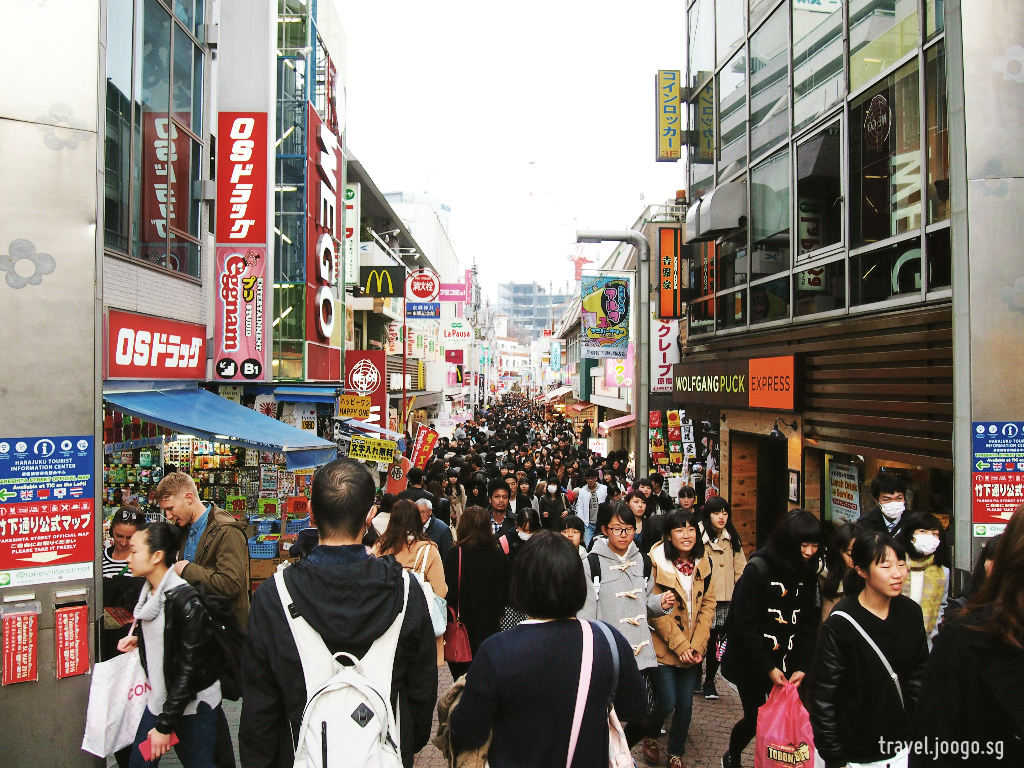
Harajuku Tokyo (原宿) lies between Shinjuku and Shibuya on the Yamanote Line. If you’re all excited about the shopping in Harajuku, you’re at the right place! Other than joining the young crowd at Takeshita Dori and the mature one in Omotesando Hills, there are many other options for you: Cat Street, LaForet, Tokyu Plaza, and 

Meiji Jingu, Yoyogi Park and Ota Museum | Harajuku Tokyo (Part 1)

Meiji Jingu, Yoyogi Park and Ota Museum | Harajuku Tokyo (Part 1)

Harajuku Tokyo (原宿) lies between Shinjuku and Shibuya on the Yamanote Line. At Harajuku, you get to witness Japan’s teenage scene and eccentric fashion at Takeshita Dori (Takeshita Street). And you get to shop at stylish Omotesando Hills or the nearby hipster district, Cat Street. There’s more shopping at LaForet 

Walking Around Glitzy Ginza, Japan

Walking Around Glitzy Ginza, Japan

Ginza (銀座) is Tokyo’s famous upmarket shopping, dining and entertainment district on one of Japan’s most expensive real estate. In this district, you will be surrounded with high-end boutiques, department stores, art galleries, restaurants, night clubs and cafes.

Ginza used to be the site for silver coin mint from 1612 to 1800. Hence, the district got its name Ginza, which means “silver mint” in Japanese. However, it was only after the 1923 Great Kanto Earthquake that Ginza was reconstructed to become the luxury district as it is today.

Ginza, Japan - travel.joogo.sg


Local life and Culture


We made our first Ginza stop at the not-so-glitzy but full-of-character Tsukiji Fish Market. Find out more about this place with this post: Visiting Tsukiji Fish Market. Thereafter, we walked in the direction of Yurakucho Station and headed to the main Ginza area.

Tsukiji Fish Market 1 - travel.joogo.sg

Along the way, you can make a stop to Kabuki-za (website), the world’s only theater dedicated for kabuki performances. The original Kabuki-za building was a wooden structure built in 1889. Due to destruction and age, it was subsequently re-built 3 times in the architectural details of pre-Edo period’s castles and temples.

Kabuki is an art of showmanship which involves elaborate costumes, thick make-up, outlandish wigs, and actors’ exaggerated actions. A kabuki program is made up of several acts. Tickets are sold for individual acts and also for the entire play. For non-Japanese speaking visitors, English guides in audio or subtitles are available too.

Tokyo Subway Wall ART- travel.joogo.sg

Spotted this mural in the subway station


Shopping at Ginza, Japan


About 500m away from Kabuki-za, you will find a neo-renaissance style building that has a clock tower at the rooftop. Built in 1932, this is a landmark of Ginza and and one of the few buildings that remained standing in the area after World War II.

This is now the main building of Ginza Wako, a department store that sells luxury goods such as watches, clocks, jewellery, men’s and women’s goods, interior decor and food products.

Ginza 2 - travel.joogo.sg

In addition, Ginza Wako has other outlets peppered across Ginza, of which there’s an annex beside this clock building where you can find tea salon, cake and chocolate shop and gourmet salon. Sounds like a place to enjoy a tai-tai life! ;P

  • www.wako.co.jp/en
  • Main Building: 4-5-11 Ginza, Chuo-ku, Tokyo 104-8105
  • 10:30 am – 7:00 pm, Daily except year-end and New Year

Ginza 7 - travel.joogo.sg

Other than Ginza Wako, you can also check out other department stores such as Matsuya where you can find international high-end brands and popular high street fashion.

As you walk around Ginza, you will also notice flagship stores of many international luxury brands such as Chanel. However, most of them have begun or will start to refurbish their stores in anticipation of the flood of tourists for the 2020 Olympics.

Ginza 1a - travel.joogo.sg

But even before the Olympics, Tokyo is already way too crowded for me! >.< With that in mind, do visit Ginza on a weekend afternoon when the pedestrian zone is widened. The main street Chuo Dori (Chuo Street) will be closed off to road traffic and opened for pedestrians. The road closure is on every Saturday and Sunday from 12:00 pm to 5:00 pm (until 6:00 pm, from Apr – Sep).

In addition, if you are a short-term tourist planning to spend a lot in Ginza, do remember to bring your passport! Because you can can enjoy TAX-FREE SHOPPING at most major stores. :)

Ginza 6 - travel.joogo.sg


Food


Want to take a break and have a snack? You should head to Kimuraya’s head store in Ginza for anpan or other types of bread. Anpan is a freshly baked bread (“pan”) with a sweet filling of red bean paste (“an”). However, if bread is not filling enough, the Ginza outlet has a café, grill and restaurant above their bakery.

Ginza 4 - travel.joogo.sg

Their No.1 bestseller is Sakura Anpan with sakura topping but it was sold out when we were there. Hence we tried their No. 2 bestseller (¥162 yen, S$2), Ogura Anpan, the “original” anpan of purely bread and red bean. Kimuraya also has seasonal specials for the different seasons such as Ichigo (strawberry) and kurikabocha (chestnut and pumpkins).

Ginza 4a - travel.joogo.sg

Other than this Kimuraya outlet in Ginza, you can also find Kimuraya’s anpan at its outlets in Shinjuku and other parts of Tokyo and also at Tokyo’s major department stores.

For more about anpan’s history, bestsellers and our review on it, refer to What to Eat in Ginza Tokyo?.

  • www.kimuraya-sohonten.co.jp (in Japanese only)
  • Opened Daily except New Years Holidays
  • Hours 1F Bakery, 2F Cafe: 10:00 am – 9:00 pm (LO 8:30 pm) | 3F Grill: 10:30 am – 9:00 am (LO 8:30 pm) | 4F Restaurant: Lunch 11:00 am – 3:00pm (LO 2:30 pm), Dinner 5:00 pm – 9:00 pm (LO 8:00 pm)
  • Address 4-5-7 Ginza, Chuo-ku, Tokyo (1-minute walk from Ginza Station A9 Exit)

Ginza 5 - travel.joogo.sg

If Kimuraya’s food is not to your liking, you can also easily enjoy delectable food at one of the high-class restaurants around Ginza. Ginza offers the finest cuisine of any category, pick from Japanese, French, Italian and Chinese cuisines.

However, if you want a more affordable option, head towards Yurakucho JR station. Because over there, you will have a Japanese salary-man experience at one of Tokyo’s interesting dining districts, Yurakucho Gado-shita (“below the girder” / “underneath the railroads”).

Yurakucho Gado-shita 1 - travel.joogo.sg

Under the elevated tracks of Yurakucho JR station (between Yurakucho and Shinbashi; and Yurakucho and Tokyo), you’ll find dozens of hidden restaurants packed in small alleyways. These restaurants ranged from small Yakitori joints and Izakayas to beer halls and French wine bars.

It will be good to research which Izakaya to go to before you go. Different Izakayas have different specialties such as fish, seafood and pork. In the end, we went to Mutsumi because based on photos pasted on its glass door, its specialty is most likely pork. At Mutsumi, it costs about ¥1,645 (S$21) for a two Yakitori sticks and a Donburi set (Japanese rice bowl dish) with salad and miso soup.

For dining rules of Izakaya and our review on its food, refer to What to Eat in Ginza Tokyo?.

Yurakucho Gado-shita - travel.joogo.sg

p.s. Before we arrived at Gado-Shita, we went to the nearby JCB Plaza to redeem complimentary airport limousine tickets because we hit a certain spending on our JCB cards.


Shopping: LOFT and MUJI


If you are eating along the stretch of Gado-shita that’s between Yurakucho and Tokyo JR stations, you’re only a few minutes walk away to MUJI Flagship Store at Yurakucho.

However, when we entered the store, there’s no sign of MUJI’s familiar minimalist style — the uniform packaging and the neat display. It was only we ventured further that we saw a big red wall with the word MUJI at a staircase leading to the 2nd floor.

So it turns out that Muji is sharing the space at level 1 with a popular lifestyle chain in Japan called LOFT.  The store carries many different brands of a wide array of items – from your beauty products to bags to stationery. We snagged a sleek backpack here. Still a proud purchase so far. :P

Muji and Shop 1 - travel.joogo.sg

  • www.loft.co.jp/shop_list_en
  • 10:30 am – 9:30 pm, daily except for Sunday & PH: 10:30 am – 9:00 pm
  • Yurakucho LOFT : 1F Infos Yurakucho, 3-8-3 Marunouchi, Chiyoda-ku (next to Yurakucho Station, Exit D9)

Muji 1- travel.joogo.sg

After shopping at the first floor, we walked up to the 2nd and 3rd floor for the rest of MUJI Yurakucho. The first thing that welcomed us on the 2nd floor was Café & Meal MUJI which sells healthy food at reasonable prices.

The Cafe has a mixed rice concept (杂菜饭) where dishes were displayed like that of a ‘create your own salad’ counter. From there, choose the 2-3 dishes you want the staff to plate for your meal. Since we were still full from our lunch at Gado-shita, we had MUJI’s afternoon tea set of coffee and cake instead. The cheesecake served was surprisingly nice! :)

Muji Cafe - travel.joogo.sg

I’m sure most of you know the brand MUJI. Born in the early 1980s, it is now one of the most recognised Japanese brand worldwide. Not surprising, because as of 2015, there are 500 MUJI stores and outlets with 50% of them outside of Japan. Of which, this MUJI Flagship Store at Yurakucho is apparently the largest in the world. It carries a wide range of products from apparel, food to furniture.

Muji 4 - travel.joogo.sg

A notable section to check out is MUJI BOOKS, where 20,000 book titles are displayed on natural solid wood shelves. Sit and browse through the books in this section’s cosy corner of tables and chairs.

Muji 2 - travel.joogo.sg

Another section that amazed us was MUJI’s living space zone. There are living spaces such as the dining room in a full set up. One that’s similar to those showroom displays you usually see in Ikea.

There’s also a wide variety of household goods for you to purchase — furniture, bedding, kitchen items, bath items, curtains, rugs, storage containers, etc. And surprisingly, customer can also engage MUJI’s renovation services of interior designers and renovation specialists.

Muji 3 - travel.joogo.sg

Once again, remember to bring your passport out with you if you are a short term visitor to Japan. Because when you show your passport, you get to enjoy discount + tax free rebate on your shopping at LOFT and MUJI! :)

So, that’s about all I can say about our short visit to Ginza! Where else would you recommend us to visit or eat in Ginza? Share with us below or on our Facebook Page or Instagram. Also, bookmark this page > Overview Itinerary: Hokkaido and Tokyo (Winter/Spring 2016)

Tokyo Metropolitan Government Office, Tokyo Skytree or Tokyo Tower?

Tokyo Metropolitan Government Office, Tokyo Skytree or Tokyo Tower?

There are many places in Tokyo where you can admire the incredible panoramic views of the city. People usually head to Tokyo Metropolitan Government Office, Tokyo Skytree or Tokyo Tower. Otherwise, you can go to other sites which include Roppongi Hills, Tokyo World Trade Center, Bunkyo Civic Center and 

Visiting Tsukiji Fish Market | Ginza, Tokyo

Visiting Tsukiji Fish Market | Ginza, Tokyo

Is Tsukiji Fish Market moving? If not, what are the hours? Any good sushi here? Find out more. :) About Tsukiji Fish Market Tsukiji Market (築地市場) is a wholesale market for fish, fruits and vegetables in Tokyo. This market is the largest of its kind 

Doraemon Museum (Fujiko F. Fujio), Tokyo

Doraemon Museum (Fujiko F. Fujio), Tokyo

Fujiko Fujio Doraemon Museum 2 - travel.joogo.sg

Doraemon has been around for decades and still remains popular till this date. So the museum appeals to both children and adults who grew up with the series. I am one of those who grew up watching Doraemon cartoon series! And I love it~ What better way to reminisce it than to visit Doraemon Museum in Japan! Because we planned for this trip in Tokyo, we skipped the Doraemon Waku Waku Sky Park in New Chitose Airport. If you are an avid fan of Doraemon, you now know where you can go next. :)

But for those who don’t know who Doraemon is, it is a robotic cat who travelled from the 22nd century back in time to befriend a group of children. It has lots of gadgets in its kangaroo like front pouch to help the boy protagonist. Go watch the series or movies before heading to the museum!

The formal name of this museum is Fujiko F. Fujio Museum (藤子・F・不二雄ミュージアム) because it’s technically a museum to celebrate and showcase the work of Hiroshi Fujimoto (pen name: Fujiko F. Fujio, “Fujiko”), one of the two Japanese manga artists who created Doraemon. His other partner is Motoo Abiko and the pen name for this writing duo is Fujiko Fujio.


On Our Way to Doraemon Museum!


Fujiko Fujio Doraemon 3a - travel.joogo.sg

If you are coming from Tokyo (Shinjuku, 新宿)

  • Take Odakyu Line towards Odawara (小田原線) from Shinjuku (新宿). Check the signs on the boarding platform to board the correct train (there can be multiple train lines at the same platform). Double check the destination that’s indicated at each train car door.
  • Alight at Mukogaoka-yeun (丘遊園駅) or Noborito (登戸駅) station that are in the suburbs of Kawasaki. Depends on whether you are walking or taking the shuttle to the museum (see below). Click for train route map.
  • It takes ~20 mins on Express train and ~35 mins on Local train. (Train schedule: www.hyperdia.com/en).
  • You can use SUICA.

Fujiko Fujio Doraemon 12 - travel.joogo.sgFrom Mukogaoka-yeunNoborito Station to Doraemon Museum

There are two ways you can get from the train station to Doraemon museum:

  • By Shuttle Bus: Take the Doraemon shuttle bus to and from Noborito Station (Odakyu line or JR Nanbu line). There’s a service every 10 – 15 mins. It’s a 10 mins ride at ¥210 (S$2.60) per pax, one way.
  • By Foot: Walk about 15 – 20 mins from Mukogaoka-yeun station (South Exit) of Odakyu-line or Shuku-Gawara station of JR Nanbu line. It’s a further walk from Noborito station.

Address for your google map: 2-chome 8-1 Nagao, Tama-ku, Kawasaki-city, Kanagawa Prefecture, 214-0023

Fujiko Fujio Doraemon 3 - travel.joogo.sg

We chose to walk! Because we heard there’s interesting stuff to spot along the way. Well, we spotted a few! But probably not worth the time and effort to walk. It took us about 25 to 30 mins to walk because we stopped numerous times along the way to take pictures of the serene neighbourhood.

Fujiko Fujio Doraemon 2a - travel.joogo.sg

As you walk, you might find some of the architecture familiar. That’s probably because Fujiko was staying in Kawasaki when the duo wrote and illustrated the Doraemon manga series. We’re all inspired by our surroundings! Also, this explains why the museum is located at this part of the country.

Fujiko Fujio Doraemon 3b - travel.joogo.sg


Tickets and Admission 


As we walked on, the museum was on our right side. We had to cross a canal and a road to reach it. Be sure you have your tickets ready with you! Tickets are not sold at the museum and you must buy the tickets in advance. The tickets are also limited so that the museum wouldn’t get too crowded for people to enjoy. Do note that you can only buy up to 2 months in advance – on the 30th of each month, tickets are available for purchase for the following two months.

Fujiko Fujio Doraemon 4a - travel.joogo.sg

Ticket Information

  • How much? ¥1,000, S$12.60 (Adults); ¥700 (High School students); ¥500 (Children above 4); Free (below 3).
  • Where to buy? Loppi ticket machine at Lawson convenience stores in Japan. You can also purchase the tickets from Loppi in Hokkaido.
  • How to use Loppi? First, know when you are going – the date and the time. There are four admission time slots for you to choose from (10:00, 12:00, 14:00 or 16:00) when you purchase. Loppi is in Japanese, so you might want to refer to this guide n how to use (l-tike.com/fujiko-m/english), though it turned out to be different from the Loppi we used in Narita airport. Hence we got the Lawson staff to help us buy. :)

Fujiko Fujio Doraemon 1 - travel.joogo.sg

We bought the tickets on the first day we arrived in Japan, at Tokyo Narita airport while making our flight transfer to Hokkaido. We wanted to get it early just in case the tickets for our desired time slot were sold out. We could also buy it from Loppi in Hokkaido.

We wanted the 10am time slot because that’s when the crowd is the thinnest. If we got the later timings, e.g. 12pm, those who came in at 10am can still linger on with the 12pm crowd. That’s true, because we felt the place getting crowded as we left about 12.25pm. We spent more time than our scheduled 1.5 hr in the museum! If we were not going somewhere else, we might have even taken longer.

Fujiko Fujio Doraemon 4 - travel.joogo.sg

Admission Information

Don’t be late! Visitors must enter the museum no later than half an hour from the chosen time slot. 

We planned to reach earlier than 10am to avoid the queue. The early scheduling was a good thing because the walk took longer than expected and so there was some buffer. In the end we reached at 10am sharp and there was a queue forming outside the museum. But no worries, the staff moved the queue quite fast while the windows of Doraemon minatures will entertain you.

As you enter the doors, you will get a information booklet/map and an English/Mandarin/Korean audio guide upon request. Photography is strictly prohibited at certain areas, especially where Fujiko’s artwork is displayed.


Doraemon Cafe


Fujiko Fujio Doraemon 9 - travel.joogo.sg

Afraid that the queue will get longer, we went straight up to the Doraemon cafe at Level 3 and took a queue number. It was slow moving at the start, but suddenly the queue numbers jumped quickly to ours. I think because most of those before us went to the outdoor playground thinking it would be quite a wait and missed their turn. We probably only waited for about 5-10 minutes?

But if you are coming in later at 12, 2, 4pm, the queue will be quite a wait and 5pm is their last order. So I suggest you take a queue number first before touring the museum or taking photos at the rooftop playground.

Fujiko Fujio Doraemon 10 - travel.joogo.sg

We were well prepared with an empty stomach to dig into our brunch! With all the waiting, we only managed to dig in at 10.40 am. Since it was still early, we ordered one dish of rice casserole with soup ‎(¥1230, S$15.40) to share and a cup of coffee (¥570, S$7.15) for hubby to perk his morning.

I wasn’t expecting the food to be good in such themed restaurants, with their price premium going into cute dish presentation and cutesy everything. Prints of Doraemon and company were everywhere – from utensils to serviettes. We even took back the manga drawn coaster. :) Anyway, the cheese baked rice turned out to be cheesy-licious! The cheesy smell waffled in the air and danced on my taste buds. Don’t expect to find much ingredients though.

Moreover, the dishes were sooooooo cute! To cute to be eaten in fact. Everyone was busy taking photos of them before defacing the Doraemon to eat. :P We requested for a Doraemon latte art but was told that we can’t choose the art… but we still got a Doraemon in the end! Yays!


Around Doraemon Museum


Fujiko Fujio Doraemon 13 - travel.joogo.sg

After our brunch, we went back to Level 1 to start our museum tour. Oh! Because the museum has a limited number of audio guides, the staff didn’t allow us to bring them to the cafe. They took them back and said we could only get these guides again at level 1 just before we start our museum tour.

Exhibition Halls (1F, 2F)

There are a few exhibitions spanning from level 1 to level 2. Using the audio guide for commentary, we walked around the collection of Fujiko’s work, including his original artwork of Doraemon and other series. There is also a replica of his study room and photos of private family episodes.

(Photography is not allowed here.)

Fujiko Fujio Doraemon 8 - travel.joogo.sg

People’s Plaza, Manga Corner, Kid’s Space (2F)

As you exit the exhibition hall, you will come to a section designed for children or those young at heart. There are many gachapon machines for visitors to twist their luck and bring a mini souvenir back home. There’s also activity and play rooms for children to get crazy in and a manga section for Japanese readers to dig into the books.

Fujiko F. Fujio Theater (2F)

If you are not interested in these stuff, then go straight to the theater for a short film that’s exclusively shown at the museum. The film is shown every 20 mins.

*Spoiler Alert: What’s amazing was, when the show ended, the screen opened up to an outdoor garden/courtyard for you to exit into. Talk about a holistic experience.*

Fujiko Fujio Doraemon 5 - travel.joogo.sg

Woodcutter’s Spring (Inside the Exhibition Hall)(2F)

We need to do some backtracking here. It’s only when we exited the exhibition hall that I spotted a prominent Gian* figurine marked on the museum map with the words ‘Woodcutter’s Spring’. So we went back into the exhibition hall to find out what it is.

There, we found Gian springing out of a well when you keep moving the lever up and down (photo above)! There was a long queue to play with the lever, so we merely took a few quick photos and left.

* Gian is Takeshi Goda, the local bully of the Doraemon series.

Gift Corner Fujikoya, Museum Gift Shop (3F, 1F)

Fujiko Fujio Doraemon 11 - travel.joogo.sg

At level 3, there’s a mini gift shop that sells Doraemon snacks. Try the vanilla-flavoured Dorayaki ice cream and savour the fluffy pancakes!

More souvenir shopping awaits you at the museum gift shop at level 1. It was crowded and had a long queue at the cashier. With ready fans to grab the merchandise, their buying fuel only increased after the tour. What a good business opportunity. Hee. Even so we became their “victims” and bought a set of cute couple cups. Happy!

Rooftop Playground, Piisuke’s Lake

Fujiko Fujio Doraemon 6 - travel.joogo.sg

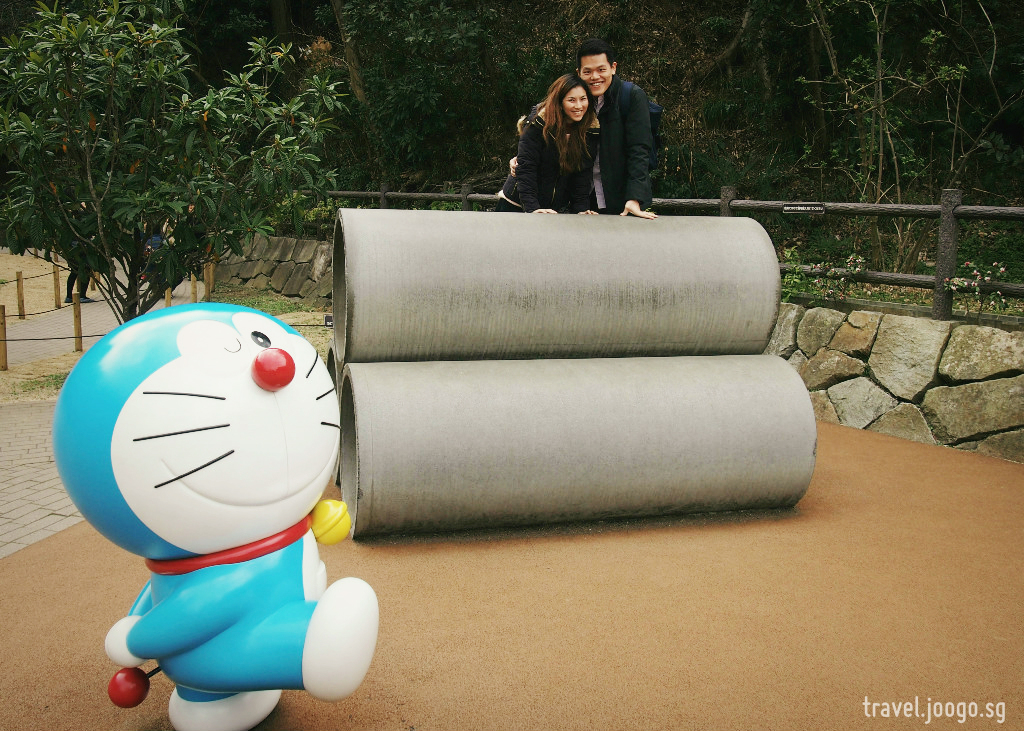
The rooftop playground has many life sized characters and scene set up for photo taking opportunities. And you should be familiar with this playground (photo above). It’s one of Doraemon series’s famous scenes – where Nobita hides whenever Gian and Suneo bully him.

We were able to capture this scene with only us because there was a queue for photos. There was a dad who ‘cut the queue’ and allowed his little girl to play around this section. People waiting in line were staring impatiently at him and only after 5 mins he said that it’s a playground, and anyone can play and there’s no need to queue. He left after 5 minutes. It’s interesting because I saw photos from other blogs where children were all over it, above and under – like the dad said – a playground. So it really depends on the crowd when you are there.

Fujiko Fujio Doraemon 7 - travel.joogo.sg

It’s fun to relive those Doraemon memories! However, if it’s your first time to Tokyo, you might want to skip this stop, unless you’re a big fan of Doraemon! It’s quite time consuming, you need to cater about 3-4 hours (including travel).

Okay time to say bye bye as I stepped through this pink door! The Dokodemo Door (Anywhere Door) is Doraemon’s commonly used gadgets to transport one anywhere just by walking through. Bye for now!

fujiko-museum.com/english
2-chome 8-1 Nagao, Tama-ku, Kawasaki-city, Kanagawa Prefecture, 214-0023
10:00-18:00 (4 entry time slots)
Closed: Every Tuesday except Golden Week (29 Apr – 5 May) and summer holidays (20 Jul – 3 Sep). New Year Holidays (30 Dec – 3 Jan). *We will announce any other special holidays in advance on this website.


Do you have questions about Doraemon Museum? Tell us below or on our Facebook Page or Instagram. Bookmark this page >> Overview Itinerary: Hokkaido and Tokyo (Winter/Spring 2016)