Tag: Information

Shows, Shopping and Food at Universal Studios Japan with Young Children (Part 2)

Shows, Shopping and Food at Universal Studios Japan with Young Children (Part 2)

This is part 2, where I will write about the shows and food at Universal Studios Japan with young children, aged 5.5 and 8 years old. You can start from Part 1 if you need more information about Universal Studios Japan (“USJ”) regarding ticketing, accommodation, the 

How to Explore Universal Studios Japan with Young Children (Part 1)

How to Explore Universal Studios Japan with Young Children (Part 1)

We were on the fence about visiting Universal Studios Japan with young children, aged 5.5 and 8 years old, during our trip. The rides at Universal Studios Japan (“USJ”) seemed more suitable for older children from Upper Primary, or so we thought. In the end, 

Why do I travel with my young children?

Why do I travel with my young children?

“It’s too troublesome and stressful,” many parents would say, “It’s work and not a holiday.” They shook their heads thinking of the children’s demands, schedules, crankiness and truckload of items. I agree. Without children in the tow, the luggage is lighter, the peace is more, and the itinerary is easier.

Thankfully (or not), we are used to taking care of the girls without much help (domestic helper or parents). Hence, it’s a similar grind when we are in another country, but with the added benefit of a change in scenery. Personally, I needed a break. Post-natal during Covid times was no joke. Grace commented I scolded them much less when we were in France. Lol.

Of course, taking care of them overseas compared to being at home means more logistics and adjustments to a new land. Well, at least my girls and I don’t have to suffer from separation anxiety, which is especially pronounced if we are going to be in different countries.

The girls and I at Luxumberoug Park in Paris

“It’s a waste of money. Children will forget, so there’s no point,” some parents reasoned. I have very vague childhood memories. Thus I understand this argument, but don’t quite agree with it. My childhood shapes who I am even when memories are forgotten. Experiences and learning are wired into children or people in general. Why read books to babies if they are going to forget the stories? Why sing nursery rhymes or recite poems to them? Why shower them with hugs and kisses when they will forget? Just kiss and read when they can remember.

Even if they absorb nothing, parents or caregivers get to build relationships with their children from these activities, same goes for travelling. Family memories created. Happy feelings remembered. Quality time spent together (with a more physically present parent who is now removed from work, provided laptop and mobile are not intruding).

Even then, I caved into doubts at times. Why am I “suffering” unnecessarily by travelling with the children? So whenever my girls mentioned moments from our travels, I get surprised. They do remember! Sometimes, I don’t even recall those moments until they brought them up. Self-justification pride sets in.

“Plane, plane!” Joy stretched her finger to the plane flying in the pastel blue sky. “Who wants to sit in an aeroplane?” “Meimei!” she yelped, her finger pointing back to herself.

“Mummy, see see! The Eiffel tower, we went there right? That’s Mona Lisa!” Grace pointed me to the advertisement playing in the crowded big brand clothing shop. We walked a few more steps, and she tugged my arm. “Mummy look, we took photos with this one!” The Winged Victory of Samothrace in the Louvre museum came into view.

Walking to Louvre Museum

Many parents sign their children up for enrichment classes to get a headstart in life. Well, travelling is one of my ways for my children. Travelling pack life experiences in a short period of time.

Flowing with hiccups and disruptions trained flexibility.

Speaking repeatedly to people who look and speak (accents) differently from us builds confidence and self-esteem.

Taking in the divergent sights, sounds and scents opens their eyes and minds.

Moving around in unfamiliar modes of transportation such as railway trains, streetcars, and horses opens them up to possibilities.

Eating different cuisines widens the palate (although my girls and I are not natural talents in this).

Strolling in the museums and streets of architecture encourages curiosity.

Enjoying God’s creation of majestic mountains and expansive grasslands invokes reverence for something bigger than us.

There probably are other reasons why parents bring children to travel. I will just end the list with this, travelling is a good way to develop respect for culture and diversity. Learning about other people’s way of life and religions promotes tolerance because what you don’t know can instil fear and irrationality.

I always thought our multi-racial society in Singapore is diverse until I travelled to Europe and came across many other races and ethnicities. Travel is also an eye-opening experience for me. One thing I love about travel is learning new things, and I wish to bring my children along my learning journey too.

Disclaimer: Other than travelling, there are many other ways for children to learn the above. Travelling is just my preferred way of educating my children.

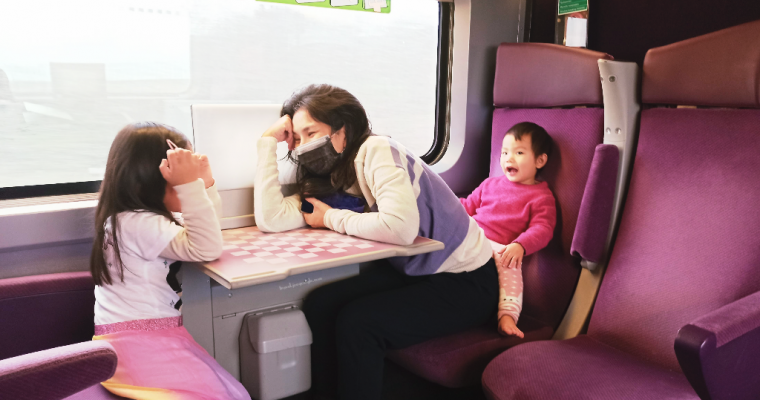
Sitting on a train and not the MRT (subway of Singapore). P.s Do you see my tired eyes? :P

You might say, “Good points, but I can bring the children when they’re older. It’ll be much easier and that’s when they truly learn.” I do wonder the same too.

That goes back to the point about young children not remembering. Like parents who sent their children to ballet classes at 2 years old, my bet, belief or faith is that my children will absorb like a sponge when they are young. I also think younger children engage more through experiential and hands-on learning than by reading facts from a book. It must be fun for the children to see things in books come to life, like getting up close with a real-life aeroplane and sitting in one!

I also want to instil in them a love of travelling, but perhaps this is more nature than nurture. Well, at least they might adapt better to travelling if they start young. Travelling can be hard for the children too as they adapt to a different bedroom, a change in schedule, and an unfamiliar environment.

The sisters enjoying their food in our Paris Airbnb’s kitchen

So strong is my personal belief about travelling, we took a calculated risk to travel with the children during Covid times. When we brought the girls along with us to Paris on a VTL flight in Nov 2021, whisperings of our irresponsible parenting could be heard.

Just go overseas yourselves, why risk the children to Covid?

The risk was assessed and calculated. There’s an illusion that it’s safer in Singapore. I read and heard of people who didn’t step out of the house unnecessarily, and yet were tested positive. To me, the probability of Covid and quarantine was the same in Singapore as overseas – 0% if you don’t get it, 100% if you get it. What’s more, our government must have assessed VTL countries as relatively safe before they opened that route.

Of course, the costs would snowball if we are positive overseas. Hence, we prayed real hard for negative results. We also had some money saved from Joy’s “free” airfare. There’s also the insurance. Speaking of which, take a look at the list on your old travel insurance policies. Dangers of travel existed during pre-covid times too — car accidents, viruses, terrorist attacks, and many others. The possibility of such mishaps is the same as Covid positive. Covid just made danger starker and thus instilling an overblown fear in people.

Moreover, we didn’t know when travel would open up and if the gates shut again from a second wave. Joy had not been overseas since birth while Grace went 3 times before she turned two. So we got out as soon as we could. I had to get a much-needed breather too. I was suffocating in Singapore — the past two years were not easy and I needed my dose of overseas air. Suffering mental health is also a cost too.

Walking down Champs Elysees Paris

I could have just flown out alone, but the girls’ were not used to other caregivers, so I didn’t want them to suffer from a sense of abandonment and adjustment. My parents flew to Bangkok without me when I was young, that gnawing memory. Joy would have it especially tough because she’s like my extension for the past two years. She only went to school after we came back from our trip. On the other hand, I would have separation anxiety from the girls too! Still, I’m looking forward to the day when the girls are older and I could slip away on a lovers’ trip with my hubby. 💕

Most importantly, I travelled because I didn’t want fear to stump the girls’ learning. Certain windows of learning only open when they are young. One of them was, albeit sounding inconsequential, I needed them to see other people talk without masks for their speech and social skills. They have already been impeded and confined much by Covid. One article that was originally published in Straits Times explains my stand further, “More young children diagnosed with developmental delays“.

In Concorde Station (Paris)

So expensive. So rich ah.

Like above, costs can snowball in positive cases. And yes, travelling is an expensive education. We did stretch our budget a bit for this big trip to France. Should we have? Like my hubby said, take it as an accumulative travel expenditure from the past two years. In addition, a bonus for my two years of hard work.

Some spent on expensive bikes, some on costly enrichments, some on luxury bags, we just chose to spend money on travelling. Money can be earned back, but mental health cannot be compromised, and learning starts early. In our opinion, we needed to bear some short term costs or risks to make sure we get to reap long term benefits.

What about you – why do you travel or not travel with your children? Leave a comment below, love to hear from you! Be kind, and write with love. :)


SAVE IT, PIN IT.


Looking for more tips on travel, home, and baby? Subscribe to my mailing list and be sure to follow me on Instagram, Facebook, and Youtube! If you like what you read here, keep it going with a small support too. :)

Disclaimer: JoogoStyle and Christina accepts no liability (whether in tort or contract or otherwise) for any loss or damage arising from any use, misuse, inaccuracy or omission of the information or other contents published on this website. 

What to Prepare for your VTL flight (Singapore)

What to Prepare for your VTL flight (Singapore)

Towards the end of 2021, more and more countries were added to Singapore’s Vaccinated Travel Lane (“VTL”) scheme. HOORAY! After two years of being contained in Singapore, the travel bug in me was bursting to fly out! At the same time, I was apprehensive. People 

Cassia Bintan Review

Cassia Bintan Review

Almost five years back, we went to Bintan for our mini honeymoon. This time, we booked a spontaneous couple trip to Bintan in September. It was baby Ex’s very first night away from us, after more than 2 years. Because the trip was last minute, 

What to Eat in Seoul, South Korea? | 15 Food Choices

What to Eat in Seoul, South Korea? | 15 Food Choices

We spent a whole week in Seoul, and that meant lots of time to try out different restaurants! Click and jump to your preferred restaurant:

  1. MiGaBon 味加本 (Porridge)
  2. Bon-Juk (Porridge)
  3. Myeongdong Kyoja (Noodles and Dumplings)
  4. Tosokchon Samgyetang (Ginseng Chicken Soup)
  5. Jinwonjo Dak Hanmari (Chicken Soup)
  6. Hanokjib Kimchi-Jjim (Kimchi Soup)
  7. Palsaik Samgyupsal (8 Colours Korean BBQ meat)
  8. Tongin Market
  9. Nene Chicken (Fried Chicken)
  10. The Original Pancake House (Pancakes)
  11. Bover Lounge (Western Food)
  12. Isaac Toast (Sandwich)
  13. 171plus Cafe (Bread and Coffee)
  14. Cafe Kong (Coffee)

1. MiGaBon 味加本 (Porridge)

Myeongdong


To power up for a day of shopping in Myeongdong, we started our day with bowls of piping hot porridge (Juk) at MiGaBon 味加本 (미가본). Would recommend this if you are in the area during autumn/winter. I still prefer the porridge in Jeju, but this ranks second before Bonjuk in Ewha.

Best to come early for breakfast to beat the queue. Make sure you join the right queue though. We jumped into the queue snaking out of the stairway, only to realise that it’s leading to the shop at level 1, Sinseon Seolleongtang 神仙雪濃湯. It’s also a famous food chain but specialises in ox-bone soup. Inside the stairway, you’ll find the queue leading to MiGaBon on level 2.

Choose from an extensive menu of more than 20 kinds of porridge — Abalone, Mushroom and Beef, King Crab, Chicken, etc. Prices range from ₩7,000 (S$8.50) to ₩20,000 (S$24.50).

Details

  • Hours: 8:00AM – 9:00PM, Daily
  • Add: 2F, 2-2, Myeongdong 2(i)-ga, Jung-gu, Seoul, South Korea; 서울특별시 중구 명동2가 2-23, 2F
  • Tel: +82 2-752-0330

2. Bon-Juk (Porridge)

EWHA (and various Locations)


Like MiGaBon, Bonjuk (본죽) has a wide variety of porridge choices. As mentioned, we preferred MiGaBon to Bonjuk. Bonjuk’s porridge felt like it came from a convenience/microwavable pack; tasted like fast food. The fact that Bonjuk has many franchise outlets islandwide makes the porridge feels even more mass market produced. Ewha branch was not crowded when we visited.

On Bonjuk’s website, you can see all the porridge choices and prices. Prices range from ₩8,000 (S$9.80) for its black porridge to ₩23,000 (S$28) for its truffle abalone or black crab-beared porridge.

Details (EWHA)


3. Myeongdong Kyoja (Noodles and Dumplings)

Myeongdong and Itaewon


Myeongdong Kyoja (명동교자) is popular among locals and foreigners alike. They have two outlets in the same street, with the main outlet beside H&M. There’s also an outlet in Itaewon. Usually there’s a long queue, but since we were there at odd hours, we got a table immediately.

Do order their famous dishes — Kalguksu (soup noodle) and Mandu (dumplings). Remember to eat their free flow of garlicky kimchi! Hubby loves their kimchi here, he loves garlic, so yeah. The shop claims to be the founder of handmade Kalguksu noodles, in which the knife cut up the dough into thin slices of noodles. Total damage for these 2 dishes was ₩18,000 (S$22).

Details (Main Outlet)

  • Hours: 10:30AM – 9:30PM
  • Add: 29, Myeong-dong 10-gil, Jung-gu, Seoul, South Korea
  • Tel: +82 2-776-5348
  • Website: www.mdkj.co.kr/en/menu/all_menu.php (Refer to footer of website for other outlets’ addresses and telephones)

4. Tosokchon Samgyetang (Ginseng Chicken Soup)

Tongui, Near Gyeongbokgung Station


The first time I visited Seoul 10 years ago, everyone was shocked I didn’t try Korea’s Ginseng Chicken Soup (Samgyetang). Hence, this time I made it a point to try it. And since we were visiting Gyeongbokgung Palace, we visited the nearby Tosokchon Samgyetang (토속촌 삼계탕). Albeit touristy, it’s a popular restaurant that many locals patronize too.

We were expecting a long queue. Hence, we were pleasantly surprised that we got ushered to a table upon arrival. The Hanok-style restaurant is huge, with a seating capacity of 400. So I supposed even if there’s a queue, it will move quite fast. In traditional seating style, most people were seated without footwear on the wooden floor. So wear shoes that’s easy to take off!

We went for the signature ginseng chicken soup ₩16,000 (S$19.50). Or for an “upgraded version”, Black Chicken Ginseng Soup is available at ₩23,000 (S$28). Initially we wanted to order rice for our soup but seeing that no one ordered, we refrained ourselves. Good we didn’t embarrass ourselves. Glutinous rice was hidden in the chicken!

Each of us was served a small cup of ginseng liquor. It’s to be drunk before the soup. I was breastfeeding and so passed my cup to hubby. The stout drinker found the ginseng liquor liquor bitter or spicy. Should be high in alcohol content.

The ginseng chicken soup is worth a try if you are nearby. Otherwise, we didn’t think it was fantastic enough for us to intentionally make our way there. We prefer the chicken soup without ginseng at Jinwonjo Dakhanmari (read on).

Details

  • Hours: 10:00AM – 10:00PM
  • Add: 5 Jahamun-ro 5-gil, Jongno-gu, Seoul, South Korea
  • Tel: +82 2-737-7444; 2-733-7444 (annex)
  • Website: tosokchon.com/index.php?lug=en

5. Jinwonjo Dak Hanmari (Chicken Soup)

Sinchon


It was a cold night, and I was craving for some soup. Walked past this chicken soup shop and decided to try it. There was no English menu or poster for us and the staff know minimal English. Without taking our orders, the staff went ahead to prepare for us when we told them it’s just us two people.

Turns out Jinwonjo Dak Hanmari (진원조닭한마리) only sells one dish, and that is chicken soup. Dak Hanmari means one whole chicken. For 2 pax, you get a whole chicken in a big soup pot for ₩20,000 (S$24.50); 3 pax, 1.5 chicken for ₩30,000 (S$36.60); 4 pax, 2 chickens for ₩40,000 (S$48.80).

Minimum order is for 2 pax, but since the portion is quite big, you can order 3pax for 4 people and add on other stuff. Not knowing how to read the menu, we didn’t have much add-on, such as potato and rice cake, to the soup.

I wanted some rice for my chicken soup, but they don’t have it. They suggested noodles and that’s what we added on. Later, I read that it’s common to leave some soup at the end of the meal and order porridge (Juk 죽) to add in. Porridge costs ₩3,000 (S$3.70) and you can order just 1 portion for 4 people.

Details

  • Hours: 11:00AM – 1:00AM
  • Add: 57-53 Changcheon-dong, Seodaemun-gu, Seoul
  • Tel: +82 2-3141-1140

6. Hanokjib Kimchi-Jjim (Kimchi Soup)

Seodaemun (and various Locations)


I am a big fan of kimchi soup. Having tried various ones around Singapore, I’m surprised that kimchi soup was not easily available in Korea. Or at least I didn’t notice it in any menu. Hence, I intentionally googled for it and found found Hanokjib Kimchi-Jjim (한옥집김치찜).

Housed in a hanok, this famous kimchi jjim restaurant ferments their kimchi for a long period of time with their unique concoction of specially sourced ingredients. With no English menu, and staff speaking limited English, we had the staff order their popular dishes for us. (Blog with menu translation into English.)

In the end, we had kimchi jjigae (stew) and kimchi jjim. Jjim is a braised dish that has less soup than jjigae. See photo above. Each of this dish is priced at ₩8,000 (S$9.80). And with the tastebuds of Koreans, the staff recommended us to add ramen noodles (₩1,000, S$1.30) into the stew. You can also add extra meat or tofu, or order more side dishes.

I didn’t know how to appreciate kimchi jjim, the taste was a bit overpowering for me. On the other hand, my hubby loves the big chunks of braised meat. I much prefer the kimchi jjigae (stew) and we finished every drop of it! :) We didn’t know then, but there is Korean instructions on the wall to eat kimchi jjim. Firstly, snip the base of the kimchi head, then tear the pork meat into smaller pieces. Lastly, wrap the long strips of kimchi around the pork and eat it with rice.

Like Tosokchon Samgyetang, this place requires you to remove footwear and sit on the wooden floor with low tables. So again, wear easy to put on shoes!

Details (Seodaemun)

  • Hours: 10:00AM – 10:00PM, Daily
  • Add: 14, Tongil-ro 9an-gil, Seodaemun-gu, Seoul, Korea (서울특별시 서대문구 통일로9안길 14)
  • Nearest Station: Seodaemun Station (Exit 3)
  • Tel: +82 2-362-8653
  • Website: www.facebook.com/hanokjib

7. Palsaik Samgyupsal (8 Colours Korean BBQ meat)

Sinchon & Hongdae


What’s coming to Korea without eating Korean BBQ? Having tried yummy Korean BBQ in Nami Island and tantalizing black pork BBQ in Jeju (still salivating from that), we wanted something special. Hence, we went to Palsaik Samgyupsal (팔색삼겹살) in Sinchon for its 8-flavoured meat, but you can also find them in Hongdae, and even overseas in US, Australia and Taiwan.

Thick-cut pork belly slices are served in eight different marinades: ginseng, wine, pine leaves, garlic, herbs, curry, miso paste, and hot. The shop name literally translates into “8 Colours Pork Belly”. For 2 pax, we ordered 400g of meat for our 8 flavours at ₩29,000 (S$35.50). For 3 pax, you can get 600g which is at ₩37,000 (S$45.20).

One thing I like about Korean BBQ in Korea is that the servers will cook and cut the meat while we just eat without the work. At Palsaik Samgyupsal, they would start cooking from the marinades with milder flavours, starting from ginseng, before ending up with the hot flavour. This is to prevent the stronger marinades to overpower the tastebuds in the beginning.

A variety of greens is served together for us to wrap the cooked meat with. There’s also free stew with every meal ordered. From seafood soybean paste, mussel soup and kimchi, we chose soybean paste to balance out the heavily spiced meat.

Details

  • Hours: 11:00AM – 11:00PM
  • Add: 27 Yonsei-ro 4-gil, Sinchon-dong, Seodaemun-gu, Seoul, South Korea (서울특별시 서대문구 신촌동 연세로4길 27)
  • Tel: +82 2-313-0183
  • Website: palsaik.com

8. Tongin Market

Tongin, Near Gyeongbokgung


Dating back to 1941, Tongin market is famous for Yeopjeon Dosirak (Yeopjeon Lunchbox). What’s interesting about this market is the use of Yeopjeon (brass coins) currency to purchase food. Pop by Tongin matket and have a meal here after visiting nearby Gyeongbukgung palace or exploring Seochon Hanok Village in the neighbourhood.

Steps to buying food in Tongin Market:

  1. Exchange cash for Yeopjeon, ₩500 (S$6.10) each. You have to buy a string of 10 brass coins each time at ₩5,000 (S$6.10). 10 coins is usually sufficient for one person. In the middle of the market, there will be someone seated at a table with black trays. Exchange currency with him.
  2. Look for stalls with membership mark on them by Yeopjeon. Usually you can buy each type of food with 1 or 2 Yeopjeon. We didn’t spot the signs but follow the crowd or simply ask the stall owners if they accept the Yeopjeon.

Against my hubby’s wishes, I insisted we try Tongin Market’s famous stir fried rice cakes, Gireum Tteokbokki (기름 떡볶이). In the end, he liked the dish more than me. There was an online recommendation: Jeong Halmony Hyojadong Tteokbokki (정할머니 효자동 옛날 떡볶이) with a yellow signboard. They sell two flavours and is priced at two Yeopjeon per serving.

With so many spicy food in our lunchboxes, I was looking forward to eating them with rice. However, the lunchbox cafe on the 2F and 3F was under renovation. Hence we went to a temporary eating space where no rice, soup and drinks were served. By right, the lunchbox cafe sells boiled rice and soup for ₩1,000 (S$1.20), where you can either pay with Yeopjeon or cash. Drinks or coffee is at ₩500 ($0.60).

The food was generally nice and experience novel. However, there were not as many food stalls as expected and the food are also more or less the same.


9. Nene Chicken (Fried Chicken)

EWHA (and various Locations)


It was our first meal in Seoul. Tired from our flight from Jeju, we simply wanted to settle our dinner somewhere near our accommodation, Ever8 Serviced Residence. Nene Chicken was a stone throw’s away.

We first tried Nene Chicken in Singapore and liked it. However, the standards deteriorated after that. The menu in Korea differs from Singapore in terms of the configuration, rather than flavours. Food was better in Korea, but not fantastic. Too bad we didn’t get the chance to visit other fried chicken restaurants in Seoul to compare.

Details (EWHA)

  • Hours: 12:00PM – 4:00AM
  • Add: 77 Yonsei-ro 2-gil, Daehyeon-dong, Seodaemun-gu, Seoul, South Korea; 서울특별시 서대문구 대현동 연세로2길 77
  • Nearest Station: Ewha Woman’s University Station
  • Tel: +82 2-3272-0036
  • Website: nenechicken.com/17_new/index.asp; english.nenechicken.com

10. The Original Pancake House (Pancakes)

Itaewon


After eating so much spicy Korean food, it’s a welcoming change to eat some pancakes! Googled for what to eat in Itaewon and The Original Pancake House came up among the top search results. Old school pancake house from the US.

A waiting crowd was by the door when we reached. An interesting mix of people that we didn’t really come across in Seoul – Caucasians, Africans, and other foreigners dressed in an electic mix. Felt like I was in downtown LA rather than Seoul.

Head over to the counter to get yourself into the waitlist. We waited around 15 minutes before we got our table. Other than their signature pancakes, we ordered fried chicken and fries. Adding on a cup of coffee, we spent ₩33,000 (S$40.50) in total.

The pancake was soft and fluffy and the fried food fried to a crisp. The sauce dip for the fried chicken was good too. We do recommend this place if you want a break from all the Korean food. Well, I guess when you see natives crowding the place for some home food, it should be nice. ;)

Details

  • Hours: 8:00AM – 9:30PM
  • Add: 172-2, Itaewon-dong, Yongsan-gu, Seoul
  • Tel: +82 2-795-7481

11. Bover Lounge (Western Food)

Myeongdong


After some shopping in Myeongdong, we were thinking of Bover Lounge for lunch. However, we didn’t call or message to reserve seats. Not wanting to risk a big detour, only to find ourselves “locked out”, we got ourselves some dumplings at Myeongdong Kyoja instead. A much cheaper option.

Heard that the coffee is definitely good though. Recommendations include omelette soufflé (S$23, ₩19,000) and shrimp blanc mousse tomato linguine (S$30, ₩24,000). Enjoy the delectable food in the restaurant with its classy decor and furniture!

Details

  • Add: 1F, 88, Hoehyeon-dong 20ga, Jung-gu, Seoul, South Korea (Myeongdong Station (Line 4, Exit 4), walk all the way straight till you see “State Tower Namsan” Building (office) on your left, Bover Lounge is at the entrance.)
  • Tel: 02-6020-5755
  • Website: www.instagram.com/bover_lounge
  • Opening Hours: 11:30AM – 11:00PM

12. Isaac Toast (Sandwich)

EWHA (and various Locations)


Shortly after Isaac Toast opened in Singapore, we found ourselves in Korea. So our first bite into their toast was in Korea instead of Singapore. Their toast breads are tasty, and hubby especially loves it. It’s also easy to take away and eat in the comfort of our hotel room while baby slept. Thus, we had these for dinner for two consecutive nights. The ingredients filled toast are affordable too, ranging from ₩2,400 (S$3.00) to ₩3,800 (S$4.70).

Details (EWHA)


13. 171plus Cafe (Bread and Coffee)

Sinchon


“I walked past this pretty cafe while on my way to Isaac Toast. We should check it out,” hubby said, handing me over my toast. The cafe was near to our accommodation, just beside boxquare. From the outside, 171plus cafe is indeed very instagrammable pretty. The inside did not disappoint too. It is artfully designed, from furniture and lighting, to the utensils and food packaging. Somewhat muji-styled, but with a girly touch.

The hot chocolate and coffee werr average, but the two breads we ordered were quite yummy. Prices are a bit on the high side though, ₩14,000 (S$17.60) in total.

Details (Sinchon)


14. Cafe Kong (Coffee)

Sinchon


Passing by the bright yellow exterior of Cafe Kong (카페콩), hubby wanted his caffeine fix. He entered into the hipster enclave and ordered a cup of coffee (₩2,000, S$2.50) for himself and a tiramisu (₩4,000, S$4.90) for me. The cakes all look good, by the way.

According to the husband, the coffee is above average but not yet exceptional. On the other hand, I ate a mouth of the tiramisu and a sense of heavenly bliss filled me. It was so so good that we went back another day to get the tiramisu again. Apparently, their earl grey cheesecake is also a popular choice among patrons.

Details


15. Paris Baguette (Bakery Cafe)

Various Places


Having first known Paris Baguette in Singapore, I had the impression it’s a high end cafe with overpriced drinks and desserts. So it came as a surprise to see Paris Baguette‘s outlets peppered across Seoul like Breadtalk in Singapore. Not super cheap, but not super expensive either. They have quite a variety of food and drinks, with kids friendly options. It’s really a good place to have our quick meal fix, especially breakfast.

Details


That’s all! Let me know of other good food in Seoul. Would love to add them into this list. For more Korea travel tips, refer to our itinerary for our South Korea trip (Jeju and Seoul).

Note that the prices and timings of all the above are subjected to changes.


If you find this post useful, be sure to bookmark this page or pin this to your Pinterest:

What to Do in Jeju, South Korea? | 11 Places to Go

What to Do in Jeju, South Korea? | 11 Places to Go

In beautiful Jeju, there are many trails to hike and climb, sea breeze to feel against your face, and mountain top experience to revel in. The focus of our trip was nature and the pace was to go slow. Turns out, my itinerary was still 

What to Eat in Jeju, South Korea? | 21 Food Choices

What to Eat in Jeju, South Korea? | 21 Food Choices

You will have no lack of food options in Jeju. In any case, there’s McDonald’s to fall back on. Here’s a list of those food that we have tried, plus others that were on our list but our stomachs have no more space for them.