Niseko is a town located in Hokkaido, Japan. Famous for its ski resorts in Japan, there are endless light powder snow, spectacular backdrop, long ski runs, trail skis and many after-ski activities. I assume you already have plans to ski or snowboard on Niseko’s powdery …
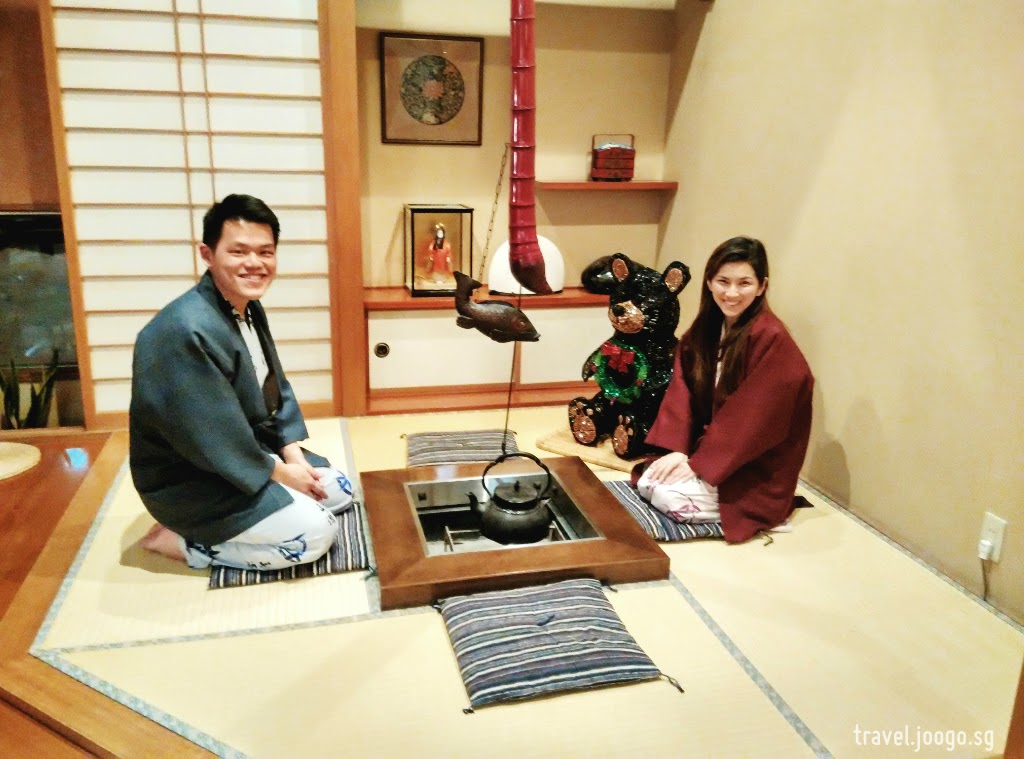
About Takinoya Bekkan Tamanoyu A main reason why we chose Noboribetsu Onsen Town over Toyako with Lake Toya is because we wanted to stay in a ryokan. So, we ended up at Takinoya Bekkan Tamanoyu (滝乃家別館 玉乃湯) at Noboribetsu. Read the previous post for the decision process and …
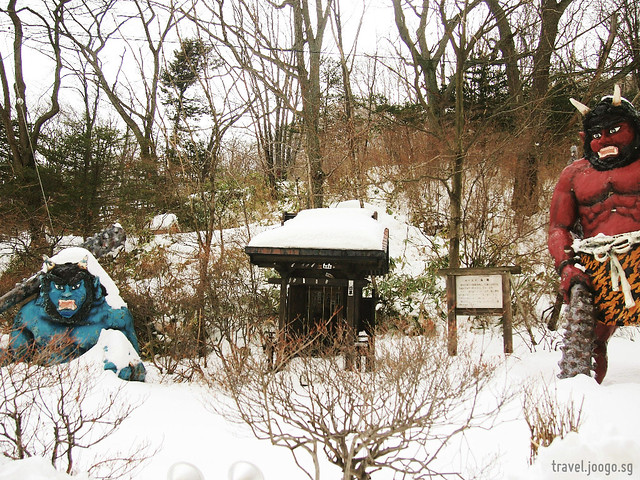
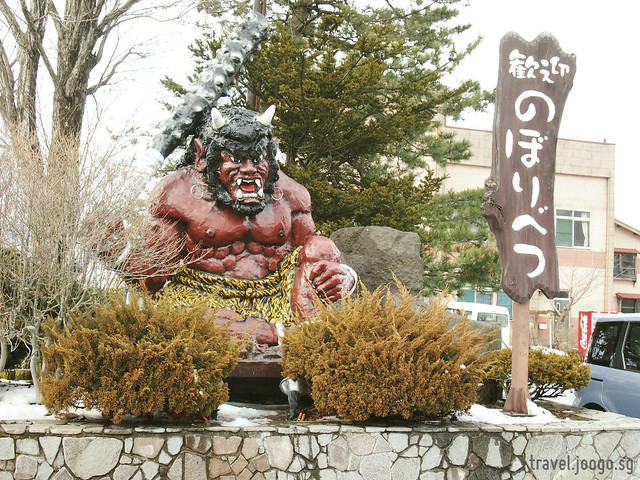
We wanted to enjoy Hokkaido’s natural hot spring (“Onsen”) and was deciding between two Onsen towns:Toyako and Noboribetsu in winter. They are near to each other, but it’s hard to travel between the two places unless you have a car. Toyako boasts of a majestic natural landscape with Lake Toya, while Noboribetsu is famous for the Hell Valley. I am not a big fan of hell and its demonic figurines.
photo: praying demon statue is enshrined with a red and blue demon guarding it
But in the end, we chose Noboribetsu because we wanted to stay in a ryokan, and we could not find a decent one at Lake Toya, where there’s not many accommodation options to begin with. Moreover, I read somewhere mentioning that Lake Toya was like Taiwan’s Sun Moon Lake, of which I was unimpressed by.
Also, Noboribetsu OnsenTownseemed to be more impressive – it is Hokkaido’s most famous and highly recommended hot spring resort. There’s supposedly eleven different kinds of thermal waters with healing properties. They are considered among Japan’s best and most effective.
We travelled on the JR from Tomamu to Noboribetsu JR Stationusing our Hokkaido railway pass. We had an hour stopover at Minami Chitose where we went to Rera Chitose Outlet Mall to pass time. Because of bad snow weather, trains were cancelled/delayed, and our reserved seats became non-reserved (this can happen – I’ll probably write more of this in another post).
photo taken outside Noboribetsu train station
From Noboribetsu JR Station to Onsen Town
Anyway, because of the train delay, we arrived at Noboribetsu JR station when the bus driver just left for his one-hour lunch break. We could have taken a taxifrom the station to Onsen Town for ¥1920(S$24), but we didn’t.
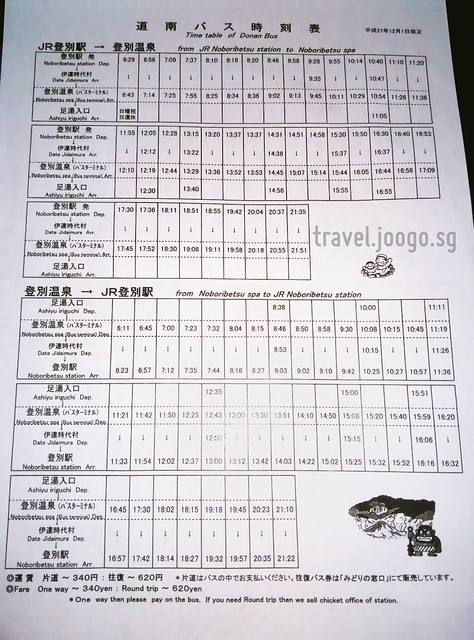
We waited less than an hour because the driver was kind enough to cut short his lunch break to pick up the stranded travellers. It’s about 15 minutes bus ride from Noboribetsu JR Station to the Onsen Town (near to Hell Valley).
We bought a round trip bus ticket at ¥620/pax (S$7.80) from the train ticket office. If not, you can buy one way ticket at ¥340/pax (S$4.30).
Board from the rear, take a numbered ticket from a machine box, then pay the bus driver when alighting in the front. If you bought the round trip ticket, you don’t need to take the numbered ticket, just pass him one of your tickets when alighting.
Leaving Noboribetsu: Journey with Uncertainties
photo taken around Noboribetsu train station
Since I’m talking about transportation, we had a rather shocking experience when we left Noboribetsu. Without unpredictable snow conditions in Singapore, we were not prepared for all the last minute disruptions weather can cause.
On the morning we checked out, we asked the receptionist for the bus timings towards the JR station. To our horror, she told us in limited English that all train operations has ceased! *Gasp* What?!Are we going to be stranded in Noboribetsu for another night?! We are going to miss our ski lesson at Niseko!!
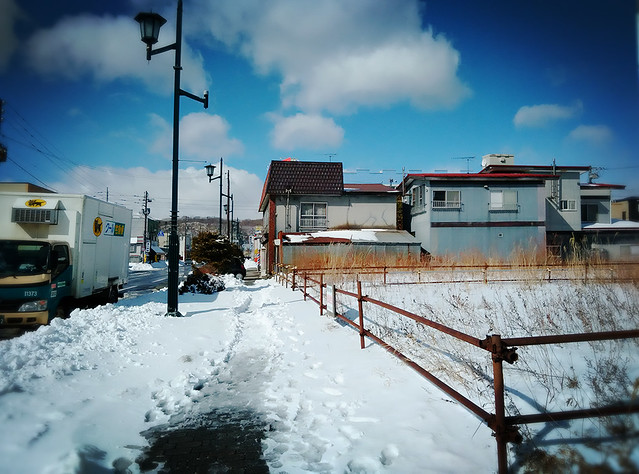
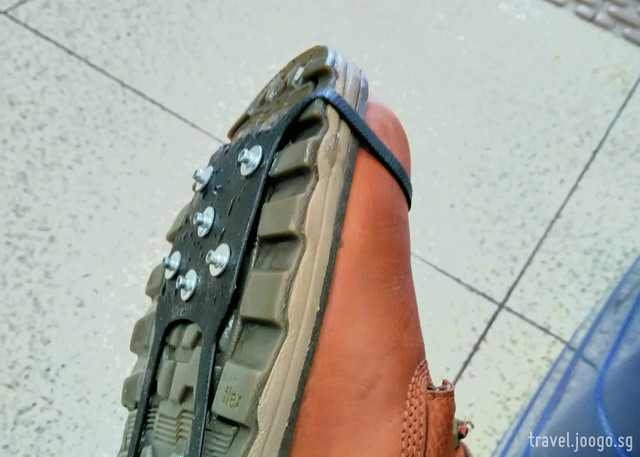
If you are going to Noboribetsu in Winter, remember to wear shoe spikes for winter! It was useful, especially when we climbed the wet and slippery slope up from the bus station to our accommodation with our luggage. But it could also be because the snow fell heavily in the morning (that’s why trains were cancelled).
When we reached in the afternoon, there were only a few hours left before the sky turned dark (it’s winter). And since we were leaving Noboribetsu the next morning, we only had time to visit Hell Valley (Jigoku-Dani), Sengen Park and walk around Onsen Town.
I would have wanted to visit Oyunuma Brook Natural Footbath, but apparently it was too cold for us to soak our legs in winter. Moreover, it’s quite a distance from where we stayed even though it’s walkable. Clustered with this Footbath are other attractions: Taisho Jigoku, Mt. Hiyori, Oyunuma, and Oku-no-yu.
I was initially interested in Noboribetsu Date Jidaimuratoo, but after reading some online reviews, I didn’t think it was worth the effort, time and money. If you must go, you can take a bus there. The other famous attraction is Noboribetsu Bear Park where you can take a ropeway to reach. I wasn’t that interested in bears.. so skipped it.
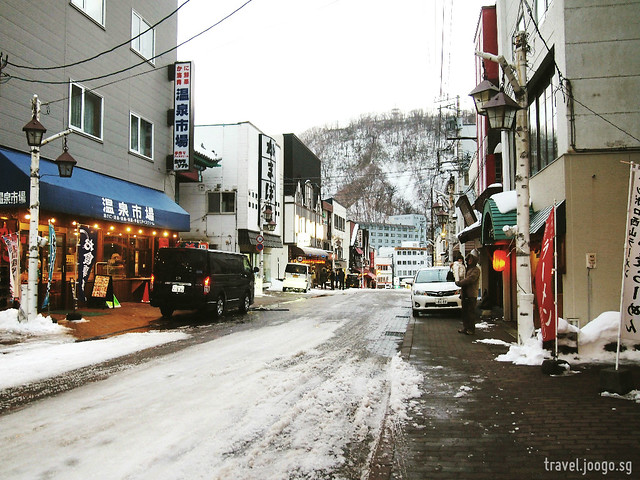
Noboribetsu Onsen Town and Food
Onsen-Hopping
Being an Onsen Town, there are onsens in most, if not all the accommodations. You can also find standalone “onsen shops”. You can hop around to try the various onsens/hot springs around Noboribetsu. You just need to pay a small fee to enter and use (incl. hotel onsen).
Our ryokan only has four small onsens (2 for male, 2 for female), while bigger hotels usually have many hot spring with different types of thermal water. However, the ryokan’s onsen was good enough for us. Read about our awesome experience at Takinoya Bekkan Tamanoyu.
Food and Shopping
We didn’t have a proper sit down lunch since we left Tomamu for Noboribetsu, and when we arrived, alas, most of the food outlets in the Onsen Town were closed! It was during the window between lunch and dinner. Sobs.
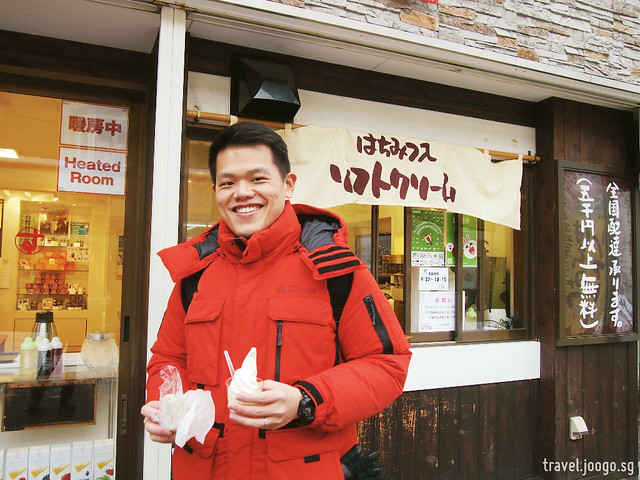
Hence, we settled for some snack and soft serve ice cream. We got the ice cream with a piping hot sweet potato snack at Sugi Yohoen (which sells a variety of honey). Not too bad. You can also get ice cream at Coffee Shop Milky House. You can also find more food at convenience store.
There were some other online recommended food we wanted to try but didn’t get to: Fukuan soba noodle shop, and Wakasaimo with beer. Wakasaimo is a baked confection made using mashed peas and beans to replicate the taste of baked yams, where yams cannot be grown in Hokkaido.
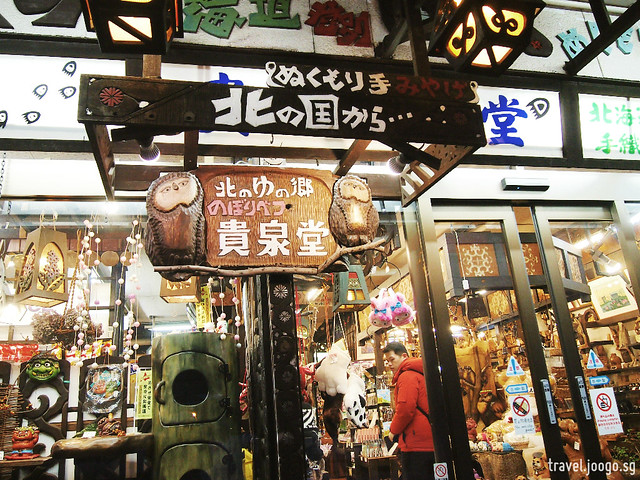
If you are not hungry, there are a couple of souvenir shops for you to buy gifts. The shops sell similar stuff along the theme of demons and owls.
Enma-Do
Walking further up the Onsen Town street towards Hell Valley, there’s an Enma-do Performance (Shrine) at 10am, 1pm, 3pm, 5pm, 8pm, 9pm* (*May-Oct). Apparently, it’s a 5 to 10 minutes robotic show.
Sengen Park
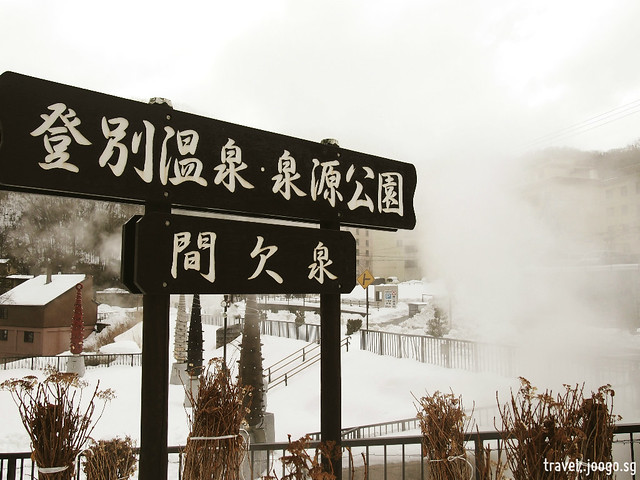
Then further up is Sengen Park, a park with a geyser erupting by the hot spring flow from Hell Valley (Jigoku-Dani).
Thank God we managed to catch the geyser’s natural symphony performance shrouded with a cloud of steam. Because apparently it happens about every three hours interval.
Hell Valley (Jigoku-Dani)
“Even though I walk through the valley of the shadow of death, I will fear no evil, for you are with me; your rod and your staff, they comfort me.” – Psalm 23:4
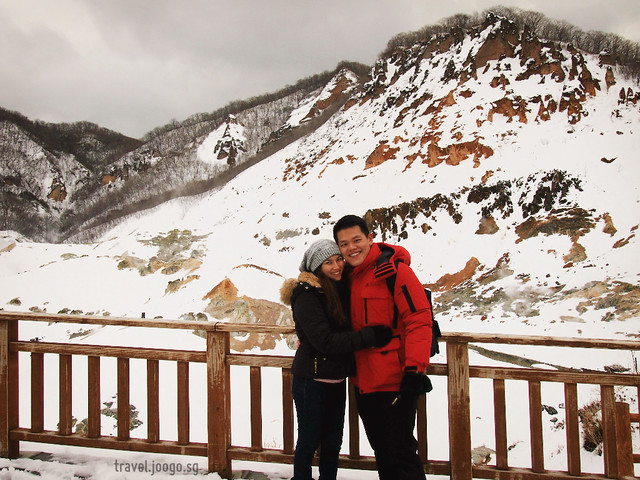
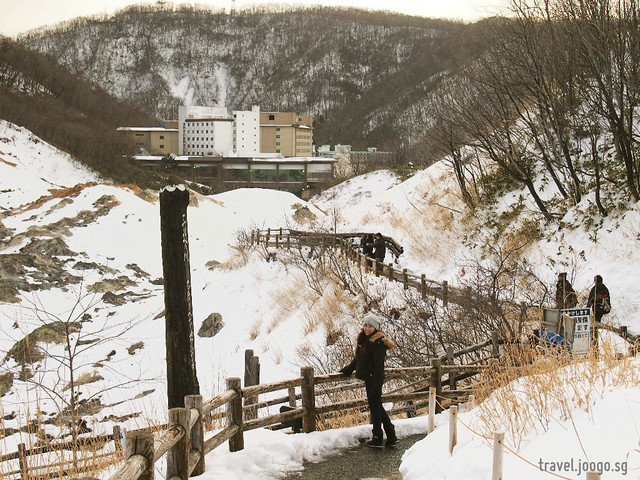
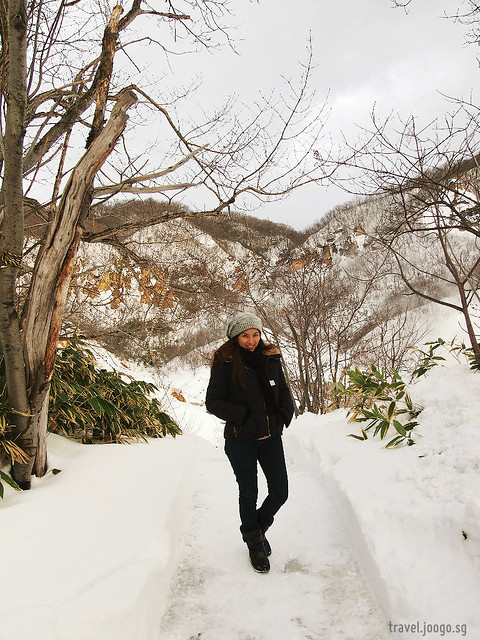
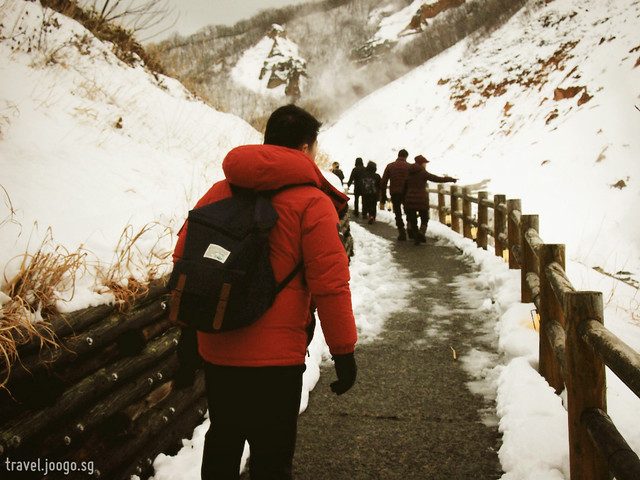
The whitewashed scenery was so so so beautiful. You can easily take photos that are Instagram, Pinterest worthy. Theme of photoshoot: Winter Sonata.
Hell Valley: Behind the Scenes
Of course, to get these beautiful pictures, there was some minor hard work behind the scenes.
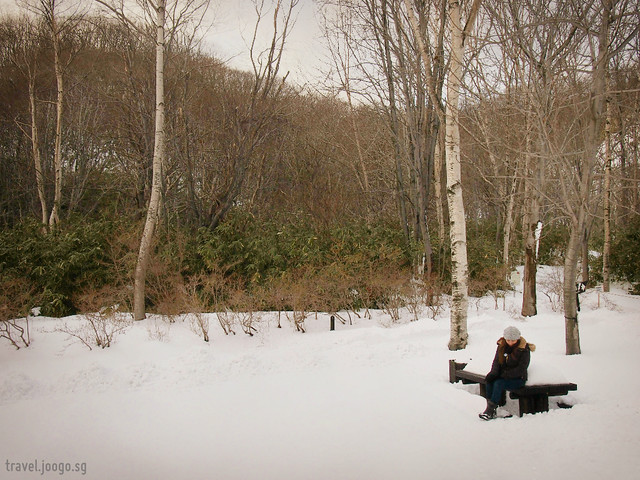
For the photo of me sitting on the bench (above), I had to trudge through the snow with my feet stepping deep into the snow – it was up to knee length – and thus making my shoes and pants wet. And when I sat on the bench with snow, my pants got wet. The price of taking beautiful photos. Hehe.
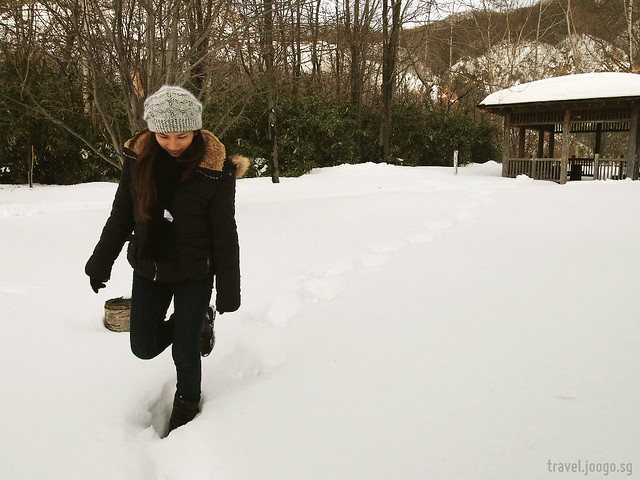
This was me taking baby steps before the knee length deep snow. Of course we had to trek up for some of the views, which wasn’t too difficult with the man-made paths and beautiful white landscape.
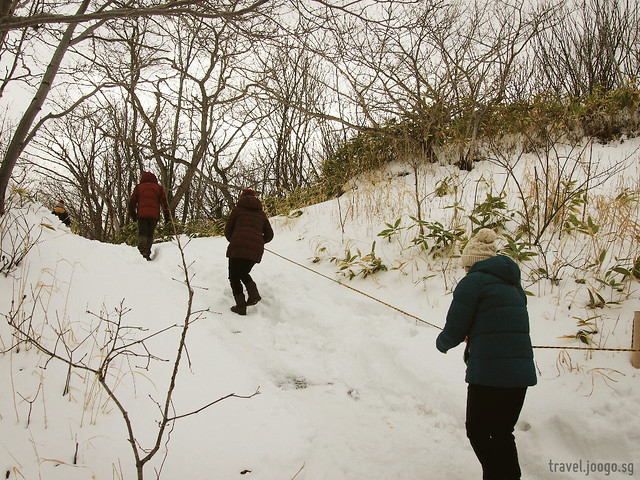
Other than trekking, we had to climb up a small slippery slope with a rope!
Oh! And there’s a strong Sulphur smell. I didn’t mind it, but some people might not like it. I especially like the Sulphur onsen in our accommodation, made my skin so smooth after that. Read about our onsen experience at the ryokan!
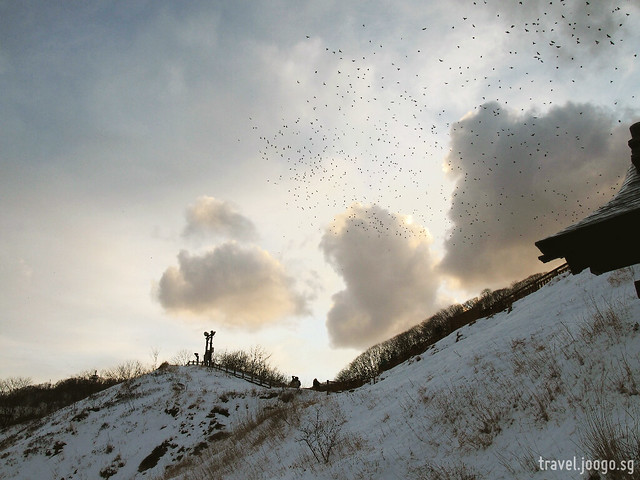
The photo with birds soaring in the sky looked awesome right? But we were in hell valley, and thousands of birds flying and crowing above us was kinda scary. Scenes of horror movies came to mind. Note to self: Not to let my future children watch horror shows and fill their minds with fear.
Tessen-Ike
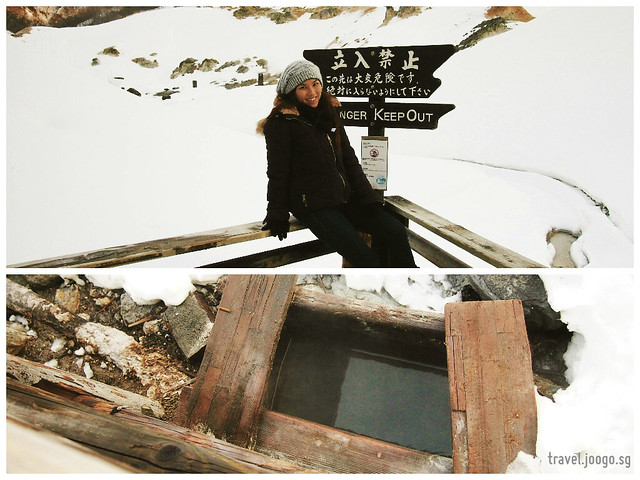
Before I end, I want to mention about Tessen-Ike, a geyser located in the center of Hell Valley. I didn’t realise we visited Tessen-Ike until I wrote this post and saw a brochure of it in its snow-less surroundings.
But I think the snow covered the geyser which was behind me (picture above). I was still wondering why there was a ‘danger keep out’ sign when there was only a small hole of calm water as we looked down from the platform.
Footsteps in the Snow
At last, leaving our footsteps behind as we left Hell Valley.
Following the bible verse I quoted in the front, I was reminded of the ‘Footprints’ poem by Mary Stevenson (excerpt):
God whispered, “My precious child, I love you and will never leave you Never, ever, during your trials and testings. When you saw only one set of footprints, It was then that I carried you.”
Do you have other questions about Noboribetsu? Ask us below or on our Facebook Page or Instagram.
Continuing from Part 1 with useful information of transportation in Hokkaido, I was contemplating whether to write about our experience. I decided to go ahead because I know it will prep you better for whatever that might happen while travelling on the JR Train in Hokkaido during winter.I …
I think it really pays off to research about the transportation in Hokkaido, Tokyo, or Japan for that matter, before you fly over. It will save you time and money, and you will less likely be overwhelmed and be lost in the complex transportation system. A Singaporean friend living in Tokyo for a few …
We detoured to Tomamu from the route of ‘Sapporo – Noboribetsu – Niseko’. This detour costs us about an additional S$100+/pax! So what’s the big deal at Tomamu? I wanted to visit Tomamu ICE VILLAGE!
Hokkaido Japan has many winter festivals, notably the Sapporo Snow Festival, and ice villages during the end and beginning of a year. However, the time of our travel was in late February, and most of them were already over by then. Good thing that there’s still one at Tomamu and it’s not too far away from Sapporo and usually begins from early December to mid-March, depending on the weather conditions.
Ice Village
Opening Hours and Directions
The ice village opens from 5:00 pm to 9:00pm (last entry 9.30pm) and is free of charge!
You have to first get to where Hal Dining (Alpha Resort) is by the 1) tube walk or 2) internal shuttle bus and alight at the bus stop “Ice Village”. Then from Hal Dining, follow the signs and find your way out of the building to the other side, walk down and up some slopes and stairs to get to the ice village. It’s about 5-10 minutes walk.
Important Tips
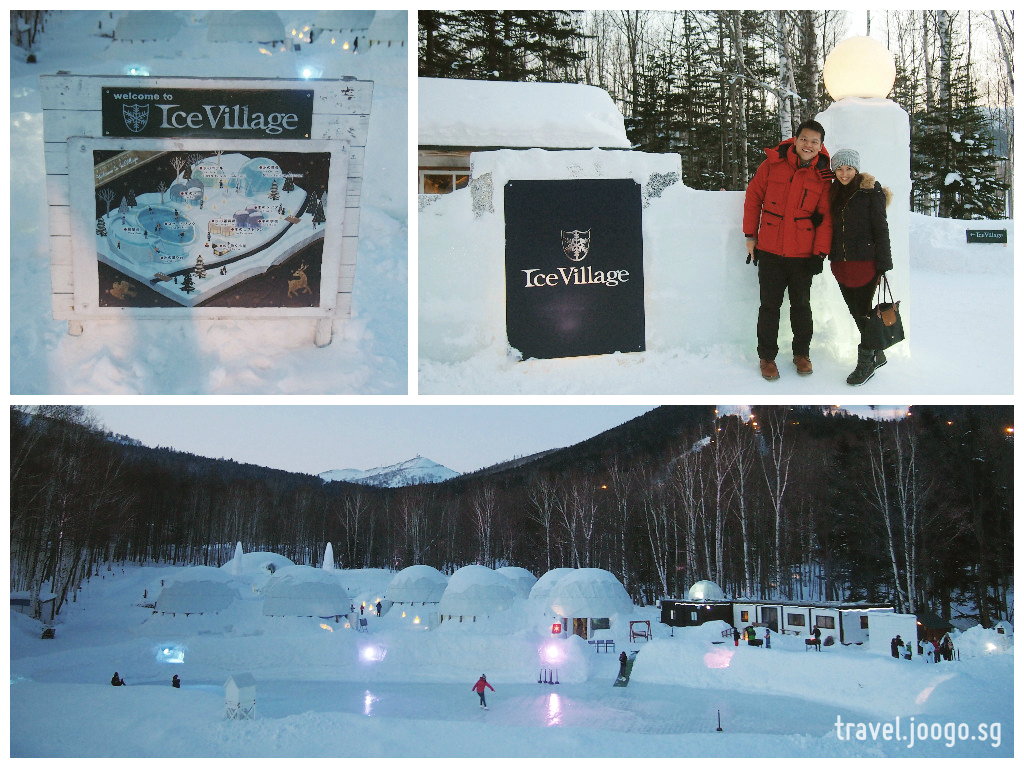
This ice village appears only in winter at Tomamu and the temperature is about -20 degrees throughout. If you are not geared up for such a temperature, you can grab a winter jacket at the entrance to the village. It’s free! Look out for the gingerbread house (picture above) as soon as you past the gate. The white jacket you see me wearing in the photo below is theirs!
Tip: Go as early as 5:00pm if possible to avoid the crowd. Most people will still be unwinding from their ski. Also, there will be a higher chance you can get the extra clothing. And of course, it gets colder later in the night!
Before we entered the village, we climbed up a flight of stairs to have a good view of the whole village. After that, you can slide down an ice slide or walk down the stairs to enter the village. Ice, ice baby, it’s solid ice everywhere.
What can you expect?
After the slide, there were a few fireplacesto warm our hands, and a warm cabin for us to enter and defrost. Yes, I was freezing up after standing around for a few minutes.
Here’s Tomamu Ice Village map to guide you if you don’t want to get lost in the ice village (it’s too small for you to get lost, but just in case):
The big ice skating rink in the village is open to the public. Some brought their own skates, but for most people you can rent a pair of adult skates at ¥1,000 (S$12.55) and a pair of children skates (6-12 yo) at ¥500 (S$6.30) in the warm cabin.
As we walked on, the various buildings made of ice fascinated us. They mimicked the igloos!
You can actually order alcohol in their ice bar and they will serve you in ice cups. Also you can order food and deserts in the ice restaurant. Sit on the ice chairs and they will serve the food and drinks to your ice table. If you have a sweet tooth, you can also dig into a dessert buffet after dinner! After filling your stomach you can go shopping at the ice souvenir shop.
An ice theater was showing animation in Japanese. It would be better if there was subtitles. But it’s nice to see the Japanese children sitting around and enjoying the animation!
I was curious to see the ice hotel, because to think people will actually pay to stay in the cold, and on ice. If you are interested, it’s ¥20,000 (S$251) per person for one night. But be warned, you will be surrounded by ice, and the only warmth if any seemed to be the fur (?) on the ice bed.
And at last, the ice chapel! I thought we wouldn’t be able to see it when we were there during end Feb, because the website (even the map) stated that it’s opened only from 8 Jan to 14 February.
So I was really happy to be able to walk in, even though the icy church aisle was out of bounds. Imagine attending a church service in this icy place. If you are getting married, you can consider and book this church as a wedding venue to exchange vows! How cool, literally!
We probably spent an hour touring the ice village, that was without eating, drinking or skating. You might spend even more time in the ice village if there happen to be some other events going on. For example, earlier in February, there was an ice concert where a Norwegian musician played an instrument made of ice. Too bad there wasn’t any when we were there. :(
Church On Water
This famous architecture, Church on the Water is located near to the ice village. It is built by international renowned architect Tadao Ando. It only opens from 8.30pm to 9.30pm, and the resort recommended to visit after 9pm when the crowd is smaller.
We finished touring the ice village early and thus decided to go back to our room for a cup noodles dinner (you’ll know why here) and then return at 8.30pm. The cold made us so tired and we just wanted to laze around in the room. But the photos of the church was nice…and since we already spent extra to be at Tomamu, we shouldn’t miss the chance!
But… the place was underwhelming. There was not much to see. The cross was half buried in snow. We didn’t know what’s going on, and what’s this all about. Meditative music was playing in the background. We thought we missed something as quite a number of people got up when we arrived and the rest looked to the front. A flurry of activity.
Tip: Ski shoes or shoe spikes are not allowed into the church on water.
Later I realised that it’s just like any other church/cathedral where people can sit and meditate on the cross. I like to do so at St Andrews’ Cathedral in Singapore. The peace. But there were just too many people moving around here, coming in and out. I am sensitive to sounds and movements, so this was definitely not my place to be still.
Most people came by after their visit to the ice village. We kind of regretted leaving our warm comfort zone to travel back here. Think compared to the photos, there’s nothing much to see during the night and winter.
Oh well, at least we got a good sleep at Tomamu, and thereafter visited Noboribetsu where we had a superb experience!
Are you interested in Tomamu Ice Village? Do tell us below or on our Facebook Page or Instagram.
All Rights Reserved: All photos (unless credited) on travel.joogo.sg.
Disclaimer: All data and information provided on this site is for informational purposes only.
Travel.joogo.sg and/or the author shall not be held responsible for any injury, loss, expense or damage of any kind whatsoever suffered or incurred by any person who accesses or uses the information and external websites stated above.
Full disclaimer here.
We detoured to Tomamu from the route of ‘Sapporo – Noboribetsu – Niseko’. This detour costs us about an additional S$100+/pax! So what’s the big deal at Tomamu? I wanted to visit the ICE VILLAGE! Read about our ice village experience. First up, if you are planning to go Tomamu, …
There are so many beautiful places to visit in Hokkaido! If it’s your first time in Hokkaido, my guess is that you will be transiting in Sapporo for 1 or 2 days. If that’s the case, you are like us! Here’s how we travelled Sapporo in 2 …