Author: Christina

One Day Guide: Things to do in Otaru (Japan, Hokkaido)

One Day Guide: Things to do in Otaru (Japan, Hokkaido)

Otaru (小樽) is a port town steeped in rich history and home to many beautiful architecture along the picturesque canal and the busy Sakaimachi street. These rows of stone buildings were mainly former warehouses and office buildings of shipping and trade companies. They were left behind from the 

Kitaichi Glass Otaru (Hokkaido, Japan)

Kitaichi Glass Otaru (Hokkaido, Japan)

Other than the desserts and music boxes, you can also find beautiful glassware in Otaru. Kitaichi Glass (“Kitaichi”) with a century-long history is the most famous and oldest place in Otaru to discover this glassy treasure. Kitaichi is the pioneer of Otaru glass when it began in 1901 with the manufacturing 

Otaru Music Box Museum (Hokkaido, Japan)

Otaru Music Box Museum (Hokkaido, Japan)

Other than the desserts and exquisite glassware, you can also find beautiful music boxes in Otaru. Otaru Music Box Museum is a must go place if you ever visit Otaru. Also, under the same umbrella of Orgel Doh Group, there are a few other places related to music box. They’re referenced in the map below. However, I will not be writing on Accessory Market Otaru Ruri-kobo (shop), but I will include Otaru Music Box Museum Sakaimachi that’s out north of the map. Follow my trail as I start from the main building.

Otaru Map 1 - travel.joogo.sg


Main Building: Otaru Music Box Museum


Situated at Merchen intersection, at the southern end of Sakaimachi street, the main building of Otaru Music Box Museum was built in 1912 and is Otaru’s notable historic landmark. This museum shop of music boxes is also one of the biggest in Japan.

Steam Clock - travel.joogo.sg

Before you step into the museum, you’ll notice the steam clock at its entrance. This was built by Canadian horologist Raymond Saunders and gifted to Otaru by Vancouver. The steam clock is electrically operated and plays a 5-tone melody every 15 minutes and chimes on the hour. We caught the steam whistle on video. See it at the end of this post!

Sakaimachi Otaru Music Box Museum - travel.joogo.sg

Wait! Before you read on, think of a music box. What image comes to mind?

My idea of a music box is literally a box that opens to a ballerina popping up and twirling mechanically to the music. But a trip to Otaru Music Box Museum really expanded my mind!

Sakaimachi Otaru Music Box Museum 2 - travel.joogo.sg

There are more than 25,000 music boxes that come in all shapes and sizes, made with all kinds of materials. There are so many varieties that those which really came in the form of a box comprised of only a small part of the entire collection.

Sakaimachi Otaru Music Box 4 - travel.joogo.sg

Because there just so many kinds of music boxes, I had to collage the photos to squeeze in as many of them to show you the varieties. Even so, there are still some more types of music boxes I didn’t show here!

Sakaimachi Otaru Music Box 5 - travel.joogo.sg

For certain items, semi-customisation is available. For example like the hanging chime in the photo above, choose the display picture you like and then choose from the available tunes to put it inside. 

The following two photos show my favourite items in Otaru Music Box Museum. So pretty right?! I would have bought them if they were not that expensive. But then again, it’s only because of our limited shopping budget. Seeing the rows of items displayed, they are definitely not considered the shop’s high range items. 

Sakaimachi Otaru Music Box 8 - travel.joogo.sg

Certain sections of the museum are the expensive zones. For these items, there’s a display sign asking you to get staff assistance if you want to pick it up and look. Please let the staff handle the item for you and don’t be itchy hands and touch them. You will blame yourself if anything happens, because I’m sure once it’s broken, it’s considered sold at the original high price. 

Be sure to explore the 2nd floor, there’s a corner that has insanely expensive items (up to a few hundred grands!). The items in this section are all encased and thus it do look like a museum where no one will shop in but appreciate the beauty of the display items. Then again, we never know. 

Sakaimachi Otaru Music Box 7 - travel.joogo.sg

Shop Info

Sakaimachi Otaru Music Box 3 - travel.joogo.sg


Otaru Karakuri Dobutsuen (Zoo Shop)


Also under the music box museum group, Otaru Karakuri Dobutsuen has a slightly different concept with its array of stuffed toys, wooden toys, and stationery. The shop also has a Zoo theme, so expect to find “animals” all around! I didn’t go to this shop, but according to their info pamphlet, the shop with its vaulted ceiling feels like a barn or a zoo. This place is located behind the Music Box Museum (main building).

Shop Info


Yume no Oto “Character-House”


If you love Japanese cartoon characters, visit Yume no Oto “Character House” (“Yume”)! It’s beside the main Otaru Music Box Museum, across a small street. For shortcut, exit from the main museum’s side door and you will come face to face with Yume.

Character House 1 - travel.joogo.sg

This is Otaru’s specialty shop selling music boxes of cartoon characters and also other products like soft toys and stationery. There’s an incredible selection of popular characters such as Rilakkuma, Mickey and Minnie.

Moreover, it has Hokkaido’s largest selection of Studio Ghibli movie merchandise. Thus, this place is a haven for fans of their internationally-acclaimed animated films, such as My Neighbour Totoro (see the grey cat collection below) and Spirited Away.

Character House 3 - travel.joogo.sg

Shop Info

Character House 2 - travel.joogo.sg


Music Box & Handicrafts Studio: You-kobo


After looking at so many music boxes, it’s time to make your own! On the other side of Merchen Intersection from Yume, you will find You-kobo (Music box & Handicrafts Studio). Here, you can make your very own one of a kind music box with glass accessories while trying your hand at fusing and sandblasting.

From ¥1,200 (S$15), you can start making a music box. The fee increases according to your level of customisation, and it could possibly get up to ¥2,500 (S$31). Hence depending on what you want, the prices varies. First, select the accessories and a tune from a list of 1,200 tunes. Pay additional fees if you prefer to use a tune from your own CD.

We had set aside a budget to make our very own music boxes, but later realised we didn’t have more than an hour to spare for this. The whole process requires about 40 minutes to produce the music box and another 30 minutes to dry. Moreover we didn’t know it’s best to reserve a place 4 days in advance on their website. 

Shop Info


No. 2 Antique Museum (Otaru Music Box Museum Hall) 


No. 2 Antique Music Box Museum 3 - travel.joogo.sg

Walk away from the main building along Sakaimachi street and you will come to Otaru Music Box Museum Hall Number 2 (“Hall No. 2”). We had a hard time finding this place because it was too blended into its surroundings!

Compared to the main museum, Hall No. 2 is much smaller in size and most items are not on sale here. As the name suggests, it is a museum that exhibits well-preserved antique music boxes and definitely a place for vintage lovers. There are also music boxes playing high quality sounds that are like those played on musical instruments. And be sure to look out for mechanical dolls of historical value!

No. 2 Antique Music Box Museum 1 - travel.joogo.sg

The life-sized “music boxes” as shown in the photo above is known as Pierrot écrivain. It is a musical automaton that moves while two tunes played. The right hand holding the quill pen scribbles across the paper, hurriedly and then slowly, then picked up speed again before he pauses and falls asleep as the lamp dims.

No. 2 Antique Music Box Museum - travel.joogo.sg

Near to the entrance, you will also find a grand pipe organ standing in one corner. Built in 1908, this Aeolian Pipe Organ has 690 pipes and is usually played by hand, but can also be played automatically. When we arrived, the 15-minute performance on the Aeolian Pipe Organ had just ended. So be sure to take note of the timings: 10:00 / 11:00 / 12:00 / 14:00 / 15:00 / 16:00.

Shop Info

No. 2 Antique Music Box Museum 2 - travel.joogo.sg


Otaru Music Box Museum (Sakaimachi)


The Sakaimachi branch of Otaru Music Box Museum is housed in a building built in 1896 for the Iwanaga Watch Store and is now designated as a historical site by Otaru city. As you enter, you’ll see a 2.5m tall hall clock that was originally built in France in the 1890s.

Otaru Streets 8 - travel.joogo.sg

According to their pamphlet, most of their music box collection are limited editions available for purchase. However, in my opinion, it’s a small replica of the main music box museum. So if you are time-pressed and not looking to buy a music box, you can skip this stop.

Sakaimachi Otaru Music Box Museum 1 - travel.joogo.sg

Shop Info


Sights and Sounds of Otaru


Enjoy a meditative short clip I put together from the videos I took around Otaru — mainly the canal and Music Box Museum. Pardon my squinty eyes, the sun was glaring!

Next:Kitaichi Glass Otaru‘ and ‘Things to do in Otaru

Do you have other suggestions of where to go in Otaru? Tell us below or on our Facebook Page or Instagram. Bookmark this page >> Overview Itinerary: Hokkaido and Tokyo (Winter/Spring 2016)

What to Eat in Otaru? | Desserts Edition

What to Eat in Otaru? | Desserts Edition

As mentioned in my previous post of what to eat in Otaru, we stayed for a night at Dormy Inn Premium Otaru because we were making our way to Sapporo from Niseko. Hence we were able to start our day early at Sankaku Fish Market before the Sapporo crowd arrived. Yeap, most people come to Otaru 

5 Places to Eat in Otaru (Hokkaido, Japan)

5 Places to Eat in Otaru (Hokkaido, Japan)

Coming from Niseko where we skied for the first time, we would pass through Otaru before reaching Sapporo. Otaru is usually a day trip from Sapporo, but since we were on the way, we stayed one night at Dormy Inn Premium Otaru. It was a good thing, because 

First Timer: Skiing at Niseko

First Timer: Skiing at Niseko

Whether you are skiing at Niseko (Hokkaido) or elsewhere, here are some useful pointers based on our skiing experience at Niseko. Simply skip the first part about ski rental if you’re not skiing at Niseko.

It was our first time skiing and it was tiring but so fun! Moreover, it was a blessing that our first time is at Niseko because it is famous for its endless light powder snow, spectacular backdrop, long ski runs, trail skis and after-ski activities. Wait a minute, what’s powder snow? As a beginner skier, I was not sure what’s the rave about it. I first fell in love with Japan’s snow at SapporoTomamu, and then at Noboribetsu. So we came to Niseko thinking nothing can be more amazing.

Niseko Ski Trip 4 - travel.joogo.sg

Then Niseko’s soft snow fell on us and it felt… JUST LIKE POWDER! It was magical. Grabbing the soft powdery snow lying on the grounds, it was as if I was in a bottle of talcum powder. The incredible quantity of such dry and powdery snow makes Niseko a wonderful place to ski. I had asked our ski instructor and other experienced students who skied elsewhere (e.g. in Italy and Korea), and Niseko wins hands down as the best place to ski!

I’ve written separate posts on what to wear for skiing, good-to-know ski lingo, where to stay and eat at Niseko. You can also read about our Ki Niseko experience.


Ski Rental at Niseko


We rented from Grand Hirafu Rentals Gondola Shop (“Gondola Shop”) because it’s only about 200 metres away from our hotel, Ki Niseko. Actually Rhythm Snow Sports Niseko (“Rhythm”) is a better option in terms of location. It has a counter right in our hotel that’s open for retail purchases, overnight tuning, waxing services and rental returns. Moreover, we can simply order online and Rhythm will deliver the rented ski equipment and wear from the main shop to us.

Ki Niseko Rhythmics - travel.joogo.sg

However, we went with Gondola Shop in the end because of the prices. Gondola Shop’s prices were much more affordable than Rhythm’s prices. Also being noobs, we wanted to try out the sizes for the ski jacket, pants, and boots to get fitting ones. As such, Rhythm became inconvenient because its main shop was further than Gondola Shop to visit and try. We had to take a bus to Rhythm’s main shop while we can simply walk to Gondola Shop from our hotel.

Niseko Ski Rental - travel.joogo.sg

After rental, you need to think about the storage for your skis and poles. If your accommodation is a quite a distance from the slopes, you can simply leave them overnight at the rental shop near the slopes. That is if you are a guest renting and staying at the Grand Hirafu.

Ki Niseko Valet - travel.joogo.sg

For us, our ski-in ski-out accommodation was near the slopes and has a private valet. So we just leave our ski gears there after each day. More on than in our Ki Niseko experience.

Ki Niseko Valet 1 - travel.joogo.sg


Skiing at Niseko


Ski school: GoSnow

We went with Gondola Snowsports (GoSnow) because we won two full days lesson, along with our Ki Niseko 3D2N accommodation! :) GoSnow is highly recommended with its team of accredited instructors. They have private and group classes for students from 3 to 99 years old, from First Timers to Advanced. All their lessons are conducted in English. Most of their instructors are friendly, but ours was a bit more impatient. But overall, we had a good learning experience with GoSnow. :)

Niseko Ski Trip 2 - travel.joogo.sg

Ski lessons can be expensive, but it’s important to take ski lessons from certified ski instructor. Get your basics right and acquire good skiing habits and technique early on. Otherwise, it’ll be hard to unlearn the wrong stuff later on.

You might be tempted to save some money by learning from your loved ones who are good at skiing or snowboarding. However, that does not mean they are good at teaching or correcting your technique. Worse still, they might pass on their bad habits. Moreover, fights and arguments are bound to happen if the teacher is someone close to you. To further convince you, I have a friend who had a bad fall and broke his leg because he didn’t get proper lesson but a crash course from his wife.

Niseko Ski Trip 10 - travel.joogo.sg

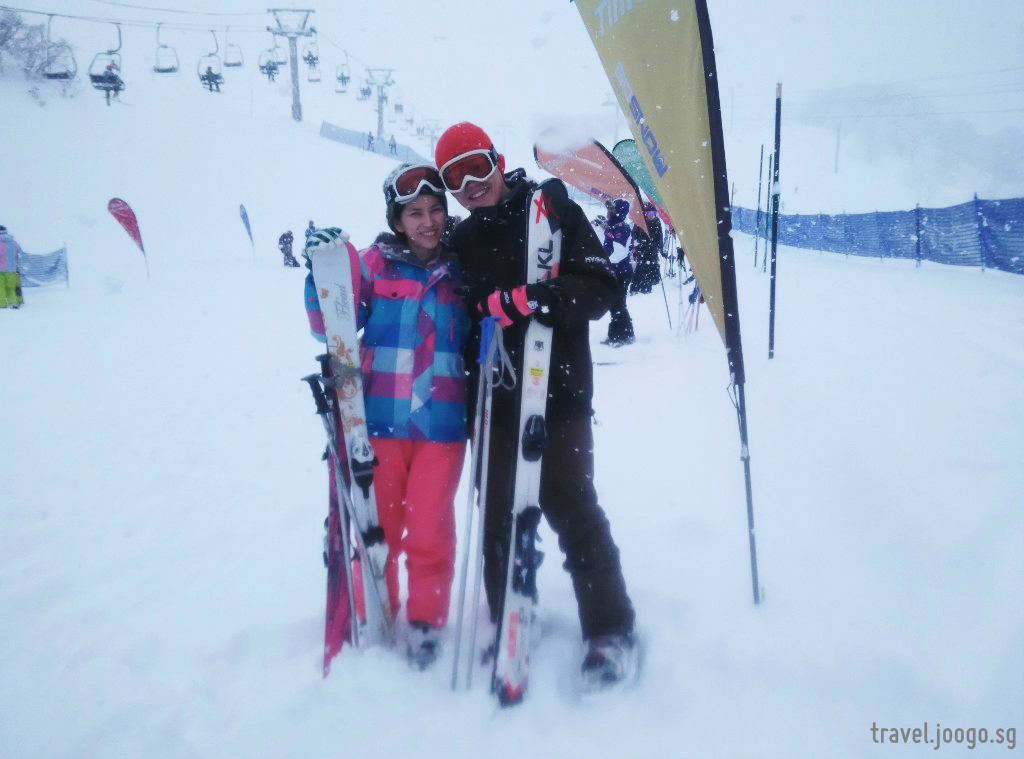
First Timers in Ski Suit

As first timers, we found it difficult to wear the ski boots and walk in the snow. To top it off, we were fumbling with the skis and poles as we tried to get our footing and walk.

I was so tired from walking a mere 100 metres on the first day of our lesson. Hubby helped me with the poles but I still had the skis. So when the school told us to report at the flags on the slope, I stopped at the first group of flags I saw. But then someone pointed out that it was the children’s section and I had to walk further up! I groaned. I was already sweating in the cold!

Niseko Ski Trip 3 - travel.joogo.sg

Eventually, I found a way that worked for me to walk in the ski boots. I shouldn’t be walking as I normally do, but bend my ankles and knees a little as if I’m kneeling. So I’d be like standing with 45 degrees forward-bent ankles and then walk in that stance.

Later on, the ski instructor taught us how to ‘click’ the skis together and then swing the skis and poles over our shoulder, like a man carrying a pole with 2 pails.

Children Skiing

It was so cute seeing the little ones learn skiing! Some of them were so good that they put us adult learners to shame. They picked up so quick with their sponge minds and flexible bodies (and low centre of gravity!). And when we were feeling fearful on the big slope* on our second day, a few children were zooming past us with ease and grace! I shall send my children to ski lessons in the future if possible. It’s good exercise and they learned to pick themselves up after a fall.

*Big slope mentioned in this post refer to the main slope where other professional skiers ski too. There’s a steep gradient towards the bottom.  

Niseko Ski Trip 5 - travel.joogo.sg

As in life, picking yourself up after a fall is not that easy! When you fall while skiing, you have to push yourself up with the ski poles using immense arm strength. The ski instructor helped us the first few times, but after a while, she would wait for us to get up on our own. “I wouldn’t always be with you,” she said. It’s especially hard on a big slope because our skis would slip down as we tried to stand on them. And it’s hard for other beginners in the class to help you because they themselves have trouble balancing on the big slope.

Ski Lesson – Day 1:

On the first day, our ski group comprised of a young Hong Kong couple in their twenties and later in the afternoon a Singaporean lady in her forties joined us. The ski instructor started off the lesson asking if we exercised on a regular basis. And when the Hong Kong lady said she doesn’t, the instructor made a comment, “You don’t exercise, but suddenly thought of doing skiing?” Woah Ohhh…

She actually made sense. Why should a sedentary person want to learn “extreme” sports like skiing just because it’s a “holiday sport”? Indeed, the lady had a hard time catching up with the lesson. But it could also be because of her poor grasp of English to understand the instructions.

Niseko Ski Trip 7 - travel.joogo.sg

Our ski instructor went on to teach us how to wear our goggles (wear them before you hit the slopes to prevent fogging), how to carry our ski equipment, the posture to ski, the technique to decrease speed and the S-curve path that prevents us from flying down the slope and crashing.

Before we hit the big slope, we started practicing on this mild slope with the children. This area is called the magic carpet because there was a machine (think flat escalator for supermarket trolleys) to bring us up the slope to ski down. The magic carpet is like a mini version of the ski lifts.

Anyway, because the Hong Kong couple weren’t able to pick up some basic skills, the instructor couldn’t take us further up the big slope on day 1. Thank God we hadn’t bought the lift pass then. The couple got the first timer package which included the lift pass, and so they went up the slope not to ski but just to enjoy the scenery.

Ski Lesson – Day 2:

On the second day, we were promoted from the first-timer to the beginner group and the group dynamics changed. With us on day 2 were a 20+ year old Caucasian guy who hadn’t skied for 10 years, a 30+ year old lady from Hong Kong and the same Singaporean lady from the first day. But by afternoon, it’s only us and the lady from Hong Kong. Will share my thoughts about that later on.

After a short refresher of Day 1, it’s time to take the ski chairlift to go up the slope! Getting up and down from the chair lift was scary for hubby and me! We had to slide into position with our skis on and wait for the fast incoming chairlift to scoop us up. Then as we alighted from the chairlift, we had to quickly jump and ski to the side. 80% of the time I would ski and tumble, but I had to quickly get up and not block the way. Even after multiple tries, getting on and off the ski lift remains a jittery process for us.

Niseko Ski Trip 8 - travel.joogo.sg

Don’t confuse the ski chairlift with the Gondola shown in the photo below. The gondola is an enclosed cable car and you have to remove your skis to board. So it’s more troublesome than the ski lift. However, if I’m not wrong, the Gondola carries the passengers further up the slope. We didn’t manage to take the Gondola.

Niseko Ski Trip 6 - travel.joogo.sg

Anyway, it was literally a steep learning curve for us. From a mild slope, we now had to ski down the big slope, and the last part was especially steep. We tended to zoom down and thus fall. To prevent such zooming, the instructor strictly instructed us to go on a S-course, but it was not easy bending my body for it. Moreover, I had to use considerable leg strength to form an inverted-v to slow down because when I went fast, the legs just wobbled out of control, and I sped even faster!

Learning to ski is like learning to cycle for the first time – you will keep falling. And like cycling, once you get the hang of it, you will enjoy it! Even though I mentioned all the fearful parts like the speed and chairlifts, hubby and I thoroughly enjoyed ourselves! We want to go back skiing again! 

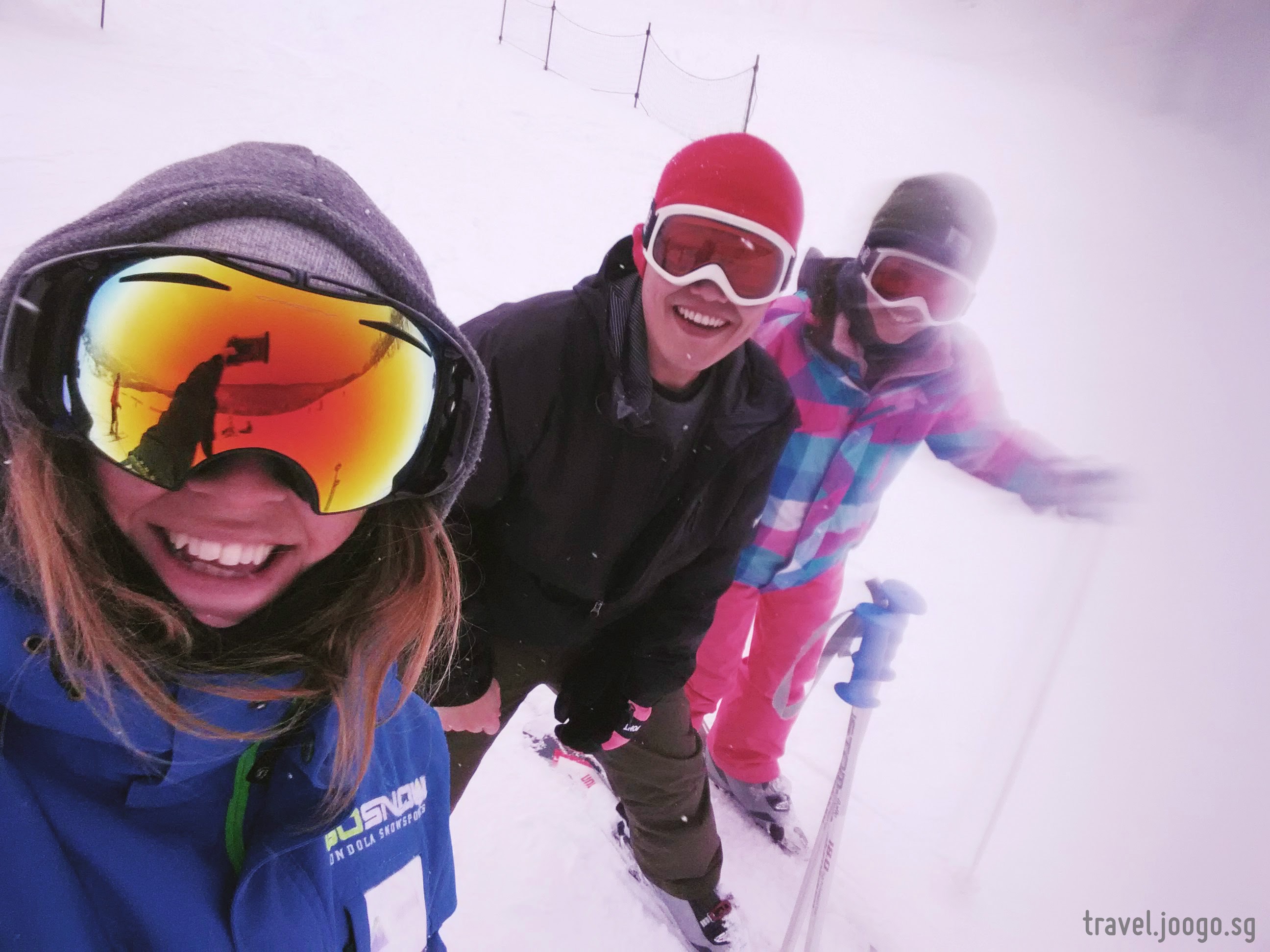
Skiing at Niseko - travel.joogo.sg

On hindsight, the way I skied reflected my personality – a fearful one. I thought I was falling down by way of speed until the instructor commented, “Woah, you really love the snow that you have to keep going down!” I had an epiphany at that moment. Most of the time, I was the one throwing myself to the the ground if I felt like I was going too fast. Instead of slowing down with my legs, I braked by falling down. It’s like in life, I will cut myself short and give up if I come across scary roadblocks.

So with her feedback for the final lap, I gritted my teeth, strengthened my legs, and psyched my heart through the scary speed. I had to tell myself not to drop to the ground. Perhaps it’s also our last ski run, hubby and I told each other to try our best not to fall, and we didn’t!!! It had seemed so impossible because we fell every time we came down the slope, multiple times in fact. Woohoo! It felt like we conquered the world! All the hard work is worth it!

Niseko Ski Trip 9 - travel.joogo.sg

One last note about the ski lesson. As mentioned earlier, the Caucasian guy (Guy) and Singaporean lady (Lady) didn’t join us for the 2nd half of day 2. Why? I assumed it’s because the Guy was frustrated and the Lady embarrassed. The Lady kept falling down and had trouble getting up. She took quite some time to get up each time as well (instructor wouldn’t help like I said earlier). Once when the Lady fell again, hubby heard the Guy sighed in frustration. It meant our precious lesson time and money were wasted waiting for a slower learner. On the other hand, it can be quite stressful being the slowest learner!

Tip 1: About ski lesson. Basically we spent the 2nd half of the day skiing down the slopes over and over again. Go for individual lesson if you have the money. If not, signed up for half day, learn from the instructor and get feedback. Then keep practising in the afternoon. It’s all about practice and that’s what we were doing during the 2nd half of the day anyway.

Niseko Ski Trip 1 - travel.joogo.sg

Tip 2: About lift pass. There’s no need to get a first timer package with day lift pass included. You might not get to use them on your first day. Even if you use the lift, it’ll probably be after lunch and you can always get the pass during lunch. Also the website did not state this, but apparently you can get lift pass by the number of rides (buying points) instead of by day or hours. 10 – 15 rides for a day should be safe, but ask your ski instructor. In any case, you should be able to get refund on the rides or hours you didn’t utilise in your pass. Check their T&Cs for the refund policy.

Niseko Ski Trip - travel.joogo.sg

Learning a new skill is tough, but it’s fun when you have learned it! And you get beautiful views too! We captured this beautiful view of Mount Yotei after we alighted from our chairlift. And with this view, we skied our way down! :) Have fun learning to ski!!

Do you have other questions about skiing at Niseko, or skiing in general? Ask us below or on our Facebook Page or Instagram. Bookmark this page >> Overview Itinerary: Hokkaido and Tokyo (Winter/Spring 2016)


All Rights Reserved: All photos (unless credited) on travel.joogo.sg. Disclaimer: All data and information provided on this site is for informational purposes only. Travel.joogo.sg and/or the author shall not be held responsible for any injury, loss, expense or damage of any kind whatsoever suffered or incurred by any person who accesses or uses the information and external websites stated above. Full disclaimer here.
First Timer’s Guide: 8 Ski Terms and Lingo

First Timer’s Guide: 8 Ski Terms and Lingo

Is it your first time skiing? Have you come across ski terms you don’t understand? Here’s a quick rundown that’s useful for first timers. I came across the last term often while researching for my FIRST ski trip. p.s. You can always drop by another post if you want to know 

First Time Skiers: What to Wear for Skiing?

First Time Skiers: What to Wear for Skiing?

I’ve written two informative posts on how to layer your clothing for the different temperatures in winter: How To Layer Clothes for Winter? (Part 1) and Layering Clothes for Winter (Part 2). I’m sensitive to the cold, so what works for me should would for you too!