Tag: Japan Things To Do

Tokyo Metropolitan Government Office, Tokyo Skytree or Tokyo Tower?

Tokyo Metropolitan Government Office, Tokyo Skytree or Tokyo Tower?

There are many places in Tokyo where you can admire the incredible panoramic views of the city. People usually head to Tokyo Metropolitan Government Office, Tokyo Skytree or Tokyo Tower. Otherwise, you can go to other sites which include Roppongi Hills, Tokyo World Trade Center, Bunkyo Civic Center and 

Visiting Tsukiji Fish Market | Ginza, Tokyo

Visiting Tsukiji Fish Market | Ginza, Tokyo

Is Tsukiji Fish Market moving? If not, what are the hours? Any good sushi here? Find out more. :) About Tsukiji Fish Market Tsukiji Market (築地市場) is a wholesale market for fish, fruits and vegetables in Tokyo. This market is the largest of its kind 

Doraemon Museum (Fujiko F. Fujio), Tokyo

Doraemon Museum (Fujiko F. Fujio), Tokyo

Fujiko Fujio Doraemon Museum 2 - travel.joogo.sg

Doraemon has been around for decades and still remains popular till this date. So the museum appeals to both children and adults who grew up with the series. I am one of those who grew up watching Doraemon cartoon series! And I love it~ What better way to reminisce it than to visit Doraemon Museum in Japan! Because we planned for this trip in Tokyo, we skipped the Doraemon Waku Waku Sky Park in New Chitose Airport. If you are an avid fan of Doraemon, you now know where you can go next. :)

But for those who don’t know who Doraemon is, it is a robotic cat who travelled from the 22nd century back in time to befriend a group of children. It has lots of gadgets in its kangaroo like front pouch to help the boy protagonist. Go watch the series or movies before heading to the museum!

The formal name of this museum is Fujiko F. Fujio Museum (藤子・F・不二雄ミュージアム) because it’s technically a museum to celebrate and showcase the work of Hiroshi Fujimoto (pen name: Fujiko F. Fujio, “Fujiko”), one of the two Japanese manga artists who created Doraemon. His other partner is Motoo Abiko and the pen name for this writing duo is Fujiko Fujio.


On Our Way to Doraemon Museum!


Fujiko Fujio Doraemon 3a - travel.joogo.sg

If you are coming from Tokyo (Shinjuku, 新宿)

  • Take Odakyu Line towards Odawara (小田原線) from Shinjuku (新宿). Check the signs on the boarding platform to board the correct train (there can be multiple train lines at the same platform). Double check the destination that’s indicated at each train car door.
  • Alight at Mukogaoka-yeun (丘遊園駅) or Noborito (登戸駅) station that are in the suburbs of Kawasaki. Depends on whether you are walking or taking the shuttle to the museum (see below). Click for train route map.
  • It takes ~20 mins on Express train and ~35 mins on Local train. (Train schedule: www.hyperdia.com/en).
  • You can use SUICA.

Fujiko Fujio Doraemon 12 - travel.joogo.sgFrom Mukogaoka-yeunNoborito Station to Doraemon Museum

There are two ways you can get from the train station to Doraemon museum:

  • By Shuttle Bus: Take the Doraemon shuttle bus to and from Noborito Station (Odakyu line or JR Nanbu line). There’s a service every 10 – 15 mins. It’s a 10 mins ride at ¥210 (S$2.60) per pax, one way.
  • By Foot: Walk about 15 – 20 mins from Mukogaoka-yeun station (South Exit) of Odakyu-line or Shuku-Gawara station of JR Nanbu line. It’s a further walk from Noborito station.

Address for your google map: 2-chome 8-1 Nagao, Tama-ku, Kawasaki-city, Kanagawa Prefecture, 214-0023

Fujiko Fujio Doraemon 3 - travel.joogo.sg

We chose to walk! Because we heard there’s interesting stuff to spot along the way. Well, we spotted a few! But probably not worth the time and effort to walk. It took us about 25 to 30 mins to walk because we stopped numerous times along the way to take pictures of the serene neighbourhood.

Fujiko Fujio Doraemon 2a - travel.joogo.sg

As you walk, you might find some of the architecture familiar. That’s probably because Fujiko was staying in Kawasaki when the duo wrote and illustrated the Doraemon manga series. We’re all inspired by our surroundings! Also, this explains why the museum is located at this part of the country.

Fujiko Fujio Doraemon 3b - travel.joogo.sg


Tickets and Admission 


As we walked on, the museum was on our right side. We had to cross a canal and a road to reach it. Be sure you have your tickets ready with you! Tickets are not sold at the museum and you must buy the tickets in advance. The tickets are also limited so that the museum wouldn’t get too crowded for people to enjoy. Do note that you can only buy up to 2 months in advance – on the 30th of each month, tickets are available for purchase for the following two months.

Fujiko Fujio Doraemon 4a - travel.joogo.sg

Ticket Information

  • How much? ¥1,000, S$12.60 (Adults); ¥700 (High School students); ¥500 (Children above 4); Free (below 3).
  • Where to buy? Loppi ticket machine at Lawson convenience stores in Japan. You can also purchase the tickets from Loppi in Hokkaido.
  • How to use Loppi? First, know when you are going – the date and the time. There are four admission time slots for you to choose from (10:00, 12:00, 14:00 or 16:00) when you purchase. Loppi is in Japanese, so you might want to refer to this guide n how to use (l-tike.com/fujiko-m/english), though it turned out to be different from the Loppi we used in Narita airport. Hence we got the Lawson staff to help us buy. :)

Fujiko Fujio Doraemon 1 - travel.joogo.sg

We bought the tickets on the first day we arrived in Japan, at Tokyo Narita airport while making our flight transfer to Hokkaido. We wanted to get it early just in case the tickets for our desired time slot were sold out. We could also buy it from Loppi in Hokkaido.

We wanted the 10am time slot because that’s when the crowd is the thinnest. If we got the later timings, e.g. 12pm, those who came in at 10am can still linger on with the 12pm crowd. That’s true, because we felt the place getting crowded as we left about 12.25pm. We spent more time than our scheduled 1.5 hr in the museum! If we were not going somewhere else, we might have even taken longer.

Fujiko Fujio Doraemon 4 - travel.joogo.sg

Admission Information

Don’t be late! Visitors must enter the museum no later than half an hour from the chosen time slot. 

We planned to reach earlier than 10am to avoid the queue. The early scheduling was a good thing because the walk took longer than expected and so there was some buffer. In the end we reached at 10am sharp and there was a queue forming outside the museum. But no worries, the staff moved the queue quite fast while the windows of Doraemon minatures will entertain you.

As you enter the doors, you will get a information booklet/map and an English/Mandarin/Korean audio guide upon request. Photography is strictly prohibited at certain areas, especially where Fujiko’s artwork is displayed.


Doraemon Cafe


Fujiko Fujio Doraemon 9 - travel.joogo.sg

Afraid that the queue will get longer, we went straight up to the Doraemon cafe at Level 3 and took a queue number. It was slow moving at the start, but suddenly the queue numbers jumped quickly to ours. I think because most of those before us went to the outdoor playground thinking it would be quite a wait and missed their turn. We probably only waited for about 5-10 minutes?

But if you are coming in later at 12, 2, 4pm, the queue will be quite a wait and 5pm is their last order. So I suggest you take a queue number first before touring the museum or taking photos at the rooftop playground.

Fujiko Fujio Doraemon 10 - travel.joogo.sg

We were well prepared with an empty stomach to dig into our brunch! With all the waiting, we only managed to dig in at 10.40 am. Since it was still early, we ordered one dish of rice casserole with soup ‎(¥1230, S$15.40) to share and a cup of coffee (¥570, S$7.15) for hubby to perk his morning.

I wasn’t expecting the food to be good in such themed restaurants, with their price premium going into cute dish presentation and cutesy everything. Prints of Doraemon and company were everywhere – from utensils to serviettes. We even took back the manga drawn coaster. :) Anyway, the cheese baked rice turned out to be cheesy-licious! The cheesy smell waffled in the air and danced on my taste buds. Don’t expect to find much ingredients though.

Moreover, the dishes were sooooooo cute! To cute to be eaten in fact. Everyone was busy taking photos of them before defacing the Doraemon to eat. :P We requested for a Doraemon latte art but was told that we can’t choose the art… but we still got a Doraemon in the end! Yays!


Around Doraemon Museum


Fujiko Fujio Doraemon 13 - travel.joogo.sg

After our brunch, we went back to Level 1 to start our museum tour. Oh! Because the museum has a limited number of audio guides, the staff didn’t allow us to bring them to the cafe. They took them back and said we could only get these guides again at level 1 just before we start our museum tour.

Exhibition Halls (1F, 2F)

There are a few exhibitions spanning from level 1 to level 2. Using the audio guide for commentary, we walked around the collection of Fujiko’s work, including his original artwork of Doraemon and other series. There is also a replica of his study room and photos of private family episodes.

(Photography is not allowed here.)

Fujiko Fujio Doraemon 8 - travel.joogo.sg

People’s Plaza, Manga Corner, Kid’s Space (2F)

As you exit the exhibition hall, you will come to a section designed for children or those young at heart. There are many gachapon machines for visitors to twist their luck and bring a mini souvenir back home. There’s also activity and play rooms for children to get crazy in and a manga section for Japanese readers to dig into the books.

Fujiko F. Fujio Theater (2F)

If you are not interested in these stuff, then go straight to the theater for a short film that’s exclusively shown at the museum. The film is shown every 20 mins.

*Spoiler Alert: What’s amazing was, when the show ended, the screen opened up to an outdoor garden/courtyard for you to exit into. Talk about a holistic experience.*

Fujiko Fujio Doraemon 5 - travel.joogo.sg

Woodcutter’s Spring (Inside the Exhibition Hall)(2F)

We need to do some backtracking here. It’s only when we exited the exhibition hall that I spotted a prominent Gian* figurine marked on the museum map with the words ‘Woodcutter’s Spring’. So we went back into the exhibition hall to find out what it is.

There, we found Gian springing out of a well when you keep moving the lever up and down (photo above)! There was a long queue to play with the lever, so we merely took a few quick photos and left.

* Gian is Takeshi Goda, the local bully of the Doraemon series.

Gift Corner Fujikoya, Museum Gift Shop (3F, 1F)

Fujiko Fujio Doraemon 11 - travel.joogo.sg

At level 3, there’s a mini gift shop that sells Doraemon snacks. Try the vanilla-flavoured Dorayaki ice cream and savour the fluffy pancakes!

More souvenir shopping awaits you at the museum gift shop at level 1. It was crowded and had a long queue at the cashier. With ready fans to grab the merchandise, their buying fuel only increased after the tour. What a good business opportunity. Hee. Even so we became their “victims” and bought a set of cute couple cups. Happy!

Rooftop Playground, Piisuke’s Lake

Fujiko Fujio Doraemon 6 - travel.joogo.sg

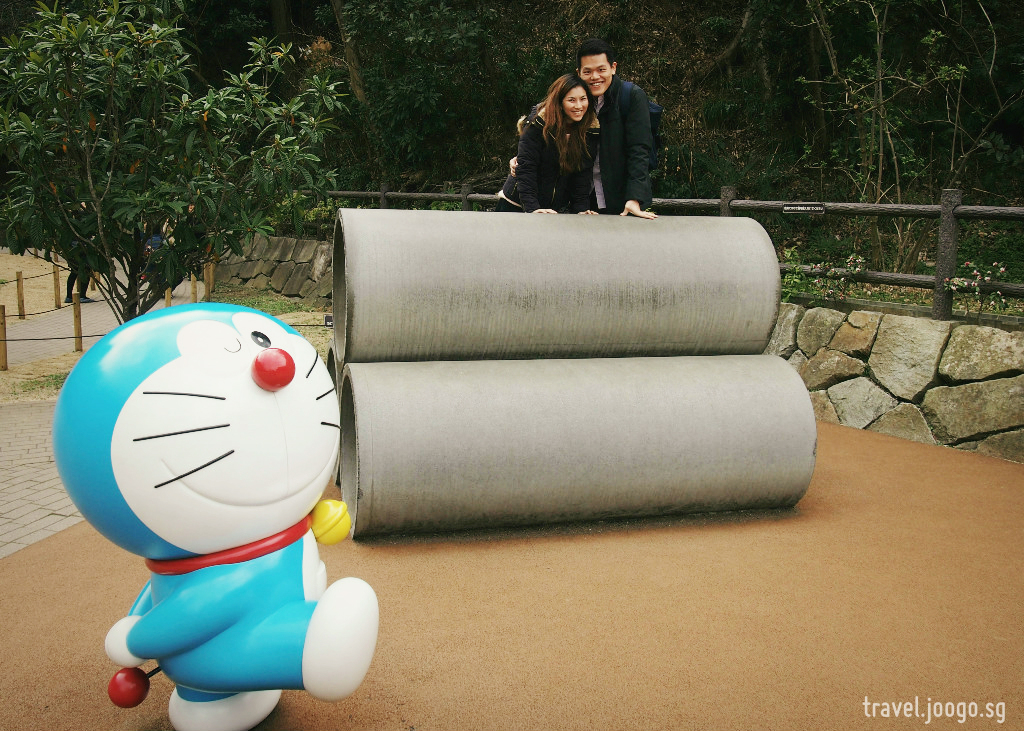
The rooftop playground has many life sized characters and scene set up for photo taking opportunities. And you should be familiar with this playground (photo above). It’s one of Doraemon series’s famous scenes – where Nobita hides whenever Gian and Suneo bully him.

We were able to capture this scene with only us because there was a queue for photos. There was a dad who ‘cut the queue’ and allowed his little girl to play around this section. People waiting in line were staring impatiently at him and only after 5 mins he said that it’s a playground, and anyone can play and there’s no need to queue. He left after 5 minutes. It’s interesting because I saw photos from other blogs where children were all over it, above and under – like the dad said – a playground. So it really depends on the crowd when you are there.

Fujiko Fujio Doraemon 7 - travel.joogo.sg

It’s fun to relive those Doraemon memories! However, if it’s your first time to Tokyo, you might want to skip this stop, unless you’re a big fan of Doraemon! It’s quite time consuming, you need to cater about 3-4 hours (including travel).

Okay time to say bye bye as I stepped through this pink door! The Dokodemo Door (Anywhere Door) is Doraemon’s commonly used gadgets to transport one anywhere just by walking through. Bye for now!

fujiko-museum.com/english
2-chome 8-1 Nagao, Tama-ku, Kawasaki-city, Kanagawa Prefecture, 214-0023
10:00-18:00 (4 entry time slots)
Closed: Every Tuesday except Golden Week (29 Apr – 5 May) and summer holidays (20 Jul – 3 Sep). New Year Holidays (30 Dec – 3 Jan). *We will announce any other special holidays in advance on this website.


Do you have questions about Doraemon Museum? Tell us below or on our Facebook Page or Instagram. Bookmark this page >> Overview Itinerary: Hokkaido and Tokyo (Winter/Spring 2016)

One Day Guide: Things to do in Otaru (Japan, Hokkaido)

One Day Guide: Things to do in Otaru (Japan, Hokkaido)

Otaru (小樽) is a port town steeped in rich history and home to many beautiful architecture along the picturesque canal and the busy Sakaimachi street. These rows of stone buildings were mainly former warehouses and office buildings of shipping and trade companies. They were left behind from the 

Kitaichi Glass Otaru (Hokkaido, Japan)

Kitaichi Glass Otaru (Hokkaido, Japan)

Other than the desserts and music boxes, you can also find beautiful glassware in Otaru. Kitaichi Glass (“Kitaichi”) with a century-long history is the most famous and oldest place in Otaru to discover this glassy treasure. Kitaichi is the pioneer of Otaru glass when it began in 1901 with the manufacturing 

Otaru Music Box Museum (Hokkaido, Japan)

Otaru Music Box Museum (Hokkaido, Japan)

Other than the desserts and exquisite glassware, you can also find beautiful music boxes in Otaru. Otaru Music Box Museum is a must go place if you ever visit Otaru. Also, under the same umbrella of Orgel Doh Group, there are a few other places related to music box. They’re referenced in the map below. However, I will not be writing on Accessory Market Otaru Ruri-kobo (shop), but I will include Otaru Music Box Museum Sakaimachi that’s out north of the map. Follow my trail as I start from the main building.

Otaru Map 1 - travel.joogo.sg


Main Building: Otaru Music Box Museum


Situated at Merchen intersection, at the southern end of Sakaimachi street, the main building of Otaru Music Box Museum was built in 1912 and is Otaru’s notable historic landmark. This museum shop of music boxes is also one of the biggest in Japan.

Steam Clock - travel.joogo.sg

Before you step into the museum, you’ll notice the steam clock at its entrance. This was built by Canadian horologist Raymond Saunders and gifted to Otaru by Vancouver. The steam clock is electrically operated and plays a 5-tone melody every 15 minutes and chimes on the hour. We caught the steam whistle on video. See it at the end of this post!

Sakaimachi Otaru Music Box Museum - travel.joogo.sg

Wait! Before you read on, think of a music box. What image comes to mind?

My idea of a music box is literally a box that opens to a ballerina popping up and twirling mechanically to the music. But a trip to Otaru Music Box Museum really expanded my mind!

Sakaimachi Otaru Music Box Museum 2 - travel.joogo.sg

There are more than 25,000 music boxes that come in all shapes and sizes, made with all kinds of materials. There are so many varieties that those which really came in the form of a box comprised of only a small part of the entire collection.

Sakaimachi Otaru Music Box 4 - travel.joogo.sg

Because there just so many kinds of music boxes, I had to collage the photos to squeeze in as many of them to show you the varieties. Even so, there are still some more types of music boxes I didn’t show here!

Sakaimachi Otaru Music Box 5 - travel.joogo.sg

For certain items, semi-customisation is available. For example like the hanging chime in the photo above, choose the display picture you like and then choose from the available tunes to put it inside. 

The following two photos show my favourite items in Otaru Music Box Museum. So pretty right?! I would have bought them if they were not that expensive. But then again, it’s only because of our limited shopping budget. Seeing the rows of items displayed, they are definitely not considered the shop’s high range items. 

Sakaimachi Otaru Music Box 8 - travel.joogo.sg

Certain sections of the museum are the expensive zones. For these items, there’s a display sign asking you to get staff assistance if you want to pick it up and look. Please let the staff handle the item for you and don’t be itchy hands and touch them. You will blame yourself if anything happens, because I’m sure once it’s broken, it’s considered sold at the original high price. 

Be sure to explore the 2nd floor, there’s a corner that has insanely expensive items (up to a few hundred grands!). The items in this section are all encased and thus it do look like a museum where no one will shop in but appreciate the beauty of the display items. Then again, we never know. 

Sakaimachi Otaru Music Box 7 - travel.joogo.sg

Shop Info

Sakaimachi Otaru Music Box 3 - travel.joogo.sg


Otaru Karakuri Dobutsuen (Zoo Shop)


Also under the music box museum group, Otaru Karakuri Dobutsuen has a slightly different concept with its array of stuffed toys, wooden toys, and stationery. The shop also has a Zoo theme, so expect to find “animals” all around! I didn’t go to this shop, but according to their info pamphlet, the shop with its vaulted ceiling feels like a barn or a zoo. This place is located behind the Music Box Museum (main building).

Shop Info


Yume no Oto “Character-House”


If you love Japanese cartoon characters, visit Yume no Oto “Character House” (“Yume”)! It’s beside the main Otaru Music Box Museum, across a small street. For shortcut, exit from the main museum’s side door and you will come face to face with Yume.

Character House 1 - travel.joogo.sg

This is Otaru’s specialty shop selling music boxes of cartoon characters and also other products like soft toys and stationery. There’s an incredible selection of popular characters such as Rilakkuma, Mickey and Minnie.

Moreover, it has Hokkaido’s largest selection of Studio Ghibli movie merchandise. Thus, this place is a haven for fans of their internationally-acclaimed animated films, such as My Neighbour Totoro (see the grey cat collection below) and Spirited Away.

Character House 3 - travel.joogo.sg

Shop Info

Character House 2 - travel.joogo.sg


Music Box & Handicrafts Studio: You-kobo


After looking at so many music boxes, it’s time to make your own! On the other side of Merchen Intersection from Yume, you will find You-kobo (Music box & Handicrafts Studio). Here, you can make your very own one of a kind music box with glass accessories while trying your hand at fusing and sandblasting.

From ¥1,200 (S$15), you can start making a music box. The fee increases according to your level of customisation, and it could possibly get up to ¥2,500 (S$31). Hence depending on what you want, the prices varies. First, select the accessories and a tune from a list of 1,200 tunes. Pay additional fees if you prefer to use a tune from your own CD.

We had set aside a budget to make our very own music boxes, but later realised we didn’t have more than an hour to spare for this. The whole process requires about 40 minutes to produce the music box and another 30 minutes to dry. Moreover we didn’t know it’s best to reserve a place 4 days in advance on their website. 

Shop Info


No. 2 Antique Museum (Otaru Music Box Museum Hall) 


No. 2 Antique Music Box Museum 3 - travel.joogo.sg

Walk away from the main building along Sakaimachi street and you will come to Otaru Music Box Museum Hall Number 2 (“Hall No. 2”). We had a hard time finding this place because it was too blended into its surroundings!

Compared to the main museum, Hall No. 2 is much smaller in size and most items are not on sale here. As the name suggests, it is a museum that exhibits well-preserved antique music boxes and definitely a place for vintage lovers. There are also music boxes playing high quality sounds that are like those played on musical instruments. And be sure to look out for mechanical dolls of historical value!

No. 2 Antique Music Box Museum 1 - travel.joogo.sg

The life-sized “music boxes” as shown in the photo above is known as Pierrot écrivain. It is a musical automaton that moves while two tunes played. The right hand holding the quill pen scribbles across the paper, hurriedly and then slowly, then picked up speed again before he pauses and falls asleep as the lamp dims.

No. 2 Antique Music Box Museum - travel.joogo.sg

Near to the entrance, you will also find a grand pipe organ standing in one corner. Built in 1908, this Aeolian Pipe Organ has 690 pipes and is usually played by hand, but can also be played automatically. When we arrived, the 15-minute performance on the Aeolian Pipe Organ had just ended. So be sure to take note of the timings: 10:00 / 11:00 / 12:00 / 14:00 / 15:00 / 16:00.

Shop Info

No. 2 Antique Music Box Museum 2 - travel.joogo.sg


Otaru Music Box Museum (Sakaimachi)


The Sakaimachi branch of Otaru Music Box Museum is housed in a building built in 1896 for the Iwanaga Watch Store and is now designated as a historical site by Otaru city. As you enter, you’ll see a 2.5m tall hall clock that was originally built in France in the 1890s.

Otaru Streets 8 - travel.joogo.sg

According to their pamphlet, most of their music box collection are limited editions available for purchase. However, in my opinion, it’s a small replica of the main music box museum. So if you are time-pressed and not looking to buy a music box, you can skip this stop.

Sakaimachi Otaru Music Box Museum 1 - travel.joogo.sg

Shop Info


Sights and Sounds of Otaru


Enjoy a meditative short clip I put together from the videos I took around Otaru — mainly the canal and Music Box Museum. Pardon my squinty eyes, the sun was glaring!

Next:Kitaichi Glass Otaru‘ and ‘Things to do in Otaru

Do you have other suggestions of where to go in Otaru? Tell us below or on our Facebook Page or Instagram. Bookmark this page >> Overview Itinerary: Hokkaido and Tokyo (Winter/Spring 2016)