Otaru (小樽) is a port town steeped in rich history and home to many beautiful architecture along the picturesque canal and the busy Sakaimachi street. These rows of stone buildings were mainly former warehouses and office buildings of shipping and trade companies. They were left behind from the …
Other than the desserts and music boxes, you can also find beautiful glassware in Otaru. Kitaichi Glass (“Kitaichi”) with a century-long history is the most famous and oldest place in Otaru to discover this glassy treasure. Kitaichi is the pioneer of Otaru glass when it began in 1901 with the manufacturing …
Other than the desserts and exquisite glassware, you can also find beautiful music boxes in Otaru. Otaru Music Box Museum is a must go place if you ever visit Otaru. Also, under the same umbrella of Orgel Doh Group, there are a few other places related to music box. They’re referenced in the map below. However, I will not be writing on Accessory Market Otaru Ruri-kobo (shop), but I will include Otaru Music Box Museum Sakaimachi that’s out north of the map. Follow my trail as I start from the main building.
Main Building: Otaru Music Box Museum
Situated at Merchen intersection, at the southern end of Sakaimachi street, the main building of Otaru Music Box Museum was built in 1912 and is Otaru’s notable historic landmark. This museum shop of music boxes is also one of the biggest in Japan.
Before you step into the museum, you’ll notice the steam clockat its entrance. This was built by Canadian horologist Raymond Saunders and gifted to Otaru by Vancouver. The steam clock is electrically operated and plays a 5-tone melody every 15 minutes and chimes on the hour. We caught the steam whistle on video. See it at the end of this post!
Wait! Before you read on, think of a music box. What image comes to mind?
My idea of a music box is literally a box that opens to a ballerina popping up and twirling mechanically to the music. But a trip to Otaru Music Box Museum really expanded my mind!
There are more than 25,000 music boxes that come in all shapes and sizes, made with all kinds of materials. There are so many varieties that those which really came in the form of a box comprised of only a small part of the entire collection.
Because there just so many kinds of music boxes, I had to collage the photos to squeeze in as many of them to show you the varieties. Even so, there are still some more types of music boxes I didn’t show here!
For certain items, semi-customisation is available. For example like the hanging chime in the photo above, choose the display picture you like and then choose from the available tunes to put it inside.
The following two photos show my favourite items in Otaru Music Box Museum. So pretty right?! I would have bought them if they were not that expensive. But then again, it’s only because of our limited shopping budget. Seeing the rows of items displayed, they are definitely not considered the shop’s high range items.
Certain sections of the museum are the expensive zones. For these items, there’s a display sign asking you to get staff assistance if you want to pick it up and look. Please let the staff handle the item for you and don’t be itchy hands and touch them. You will blame yourself if anything happens, because I’m sure once it’s broken, it’s considered sold at the original high price.
Be sure to explore the 2nd floor, there’s a corner that has insanely expensive items (up to a few hundred grands!). The items in this section are all encased and thus it do look like a museum where no one will shop in but appreciate the beauty of the display items. Then again, we never know.
9:00 am – 6:00 pm (Until 7:00 pm for summer Saturdays)
Otaru Karakuri Dobutsuen (Zoo Shop)
Also under the music box museum group, Otaru Karakuri Dobutsuen has a slightly different concept with its array of stuffed toys, wooden toys, and stationery. The shop also has a Zoo theme, so expect to find “animals” all around! I didn’t go to this shop, but according to their info pamphlet, the shop with its vaulted ceiling feels like a barn or a zoo. This place is located behind the Music Box Museum (main building).
4-1 Sumiyoshi-cho, Otaru (Behind the main building)
9:00 am – 6:00 pm
Yume no Oto “Character-House”
If you love Japanese cartoon characters, visit Yume no Oto “Character House” (“Yume”)! It’s beside the main Otaru Music Box Museum, across a small street. For shortcut, exit from the main museum’s side door and you will come face to face with Yume.
This is Otaru’s specialty shop selling music boxes of cartoon characters and also other products like soft toys and stationery. There’s an incredible selection of popular characters such as Rilakkuma, Mickey and Minnie.
Moreover, it has Hokkaido’s largest selection of Studio Ghibli movie merchandise. Thus, this place is a haven for fans of their internationally-acclaimed animated films, such as My Neighbour Totoro (see the grey cat collection below) and Spirited Away.
After looking at so many music boxes, it’s time to make your own! On the other side of Merchen Intersection from Yume, you will find You-kobo (Music box & Handicrafts Studio). Here, you can make your very own one of a kind music box with glass accessories while trying your hand at fusing and sandblasting.
From ¥1,200 (S$15), you can start making a music box. The fee increasesaccording to your level of customisation, and it could possibly get up to ¥2,500 (S$31). Hence depending on what you want, the prices varies. First, select the accessories and a tune from a list of 1,200 tunes. Pay additional fees if you prefer to use a tune from your own CD.
We had set aside a budget to make our very own music boxes, but later realised we didn’t have more than an hour to spare for this. The whole process requires about 40 minutes to produce the music box and another 30 minutes to dry. Moreover we didn’t know it’s best to reserve a place 4 days in advance on their website.
No. 2 Antique Museum (Otaru Music Box Museum Hall)
Walk away from the main building along Sakaimachi street and you will come to Otaru Music Box Museum Hall Number 2 (“Hall No. 2”). We had a hard time finding this place because it was too blended into its surroundings!
Compared to the main museum, Hall No.2 is much smaller in size and most items are not on sale here. As the name suggests, it is a museum that exhibits well-preserved antique music boxes and definitely a place for vintage lovers. There are also music boxes playing high quality sounds that are like those played on musical instruments. And be sure to look out for mechanical dolls of historical value!
The life-sized “music boxes” as shown in the photo above is known as Pierrot écrivain. It is a musical automaton that moves while two tunes played. The right hand holding the quill pen scribbles across the paper, hurriedly and then slowly, then picked up speed again before he pauses and falls asleep as the lamp dims.
Near to the entrance, you will also find a grand pipe organ standing in one corner. Built in 1908, this Aeolian Pipe Organ has 690 pipes and is usually played by hand, but can also be played automatically. When we arrived, the 15-minute performance on the Aeolian Pipe Organ had just ended. So be sure to take note of the timings: 10:00 / 11:00 / 12:00 / 14:00 / 15:00 / 16:00.
The Sakaimachi branch of Otaru Music Box Museum is housed in a building built in 1896 for the Iwanaga Watch Store and is now designated as a historical site by Otaru city. As you enter, you’ll see a 2.5m tall hall clock that was originally built in France in the 1890s.
According to their pamphlet, most of their music box collection are limited editions available for purchase. However, in my opinion, it’s a small replica of the main music box museum. So if you are time-pressed and not looking to buy a music box, you can skip this stop.
1-21, Sakaimachi, Otaru (walk away from the main building, it’s near a small stream of river)
9:00 am – 6:00 pm
Sights and Sounds of Otaru
Enjoy a meditative short clip I put together from the videos I took around Otaru — mainly the canal and Music Box Museum. Pardon my squinty eyes, the sun was glaring!
As mentioned in my previous post of what to eat in Otaru, we stayed for a night at Dormy Inn Premium Otaru because we were making our way to Sapporo from Niseko. Hence we were able to start our day early at Sankaku Fish Market before the Sapporo crowd arrived. Yeap, most people come to Otaru …
Coming from Niseko where we skied for the first time, we would pass through Otaru before reaching Sapporo. Otaru is usually a day trip from Sapporo, but since we were on the way, we stayed one night at Dormy Inn Premium Otaru. It was a good thing, because …
Double Room (Non-Smoking):hotespa.net/hotels/otaru; booked via booking.com* Price: ¥8,990 per night (~S$113), price before cashback* Duration: 1 night in March 2016 (Thursday night)
Saving Tip:We saved quite a bit by using Shopback (booking.com) to book our accommodation. We got a 6% Cashback by booking at booking.com via Shopback! *Happy* As of now, you can click on my referral link here and get an additional S$10 bonus! Sweeter than the deal I got. :P
Location
First up, the location is excellent. The hotel is just opposite the train station and you can see it the moment you step out of JR Otaru. We reached Otaru quite late in the evening and so the near proximity to the train station was a big plus for us (no need to walk too far in the freezing cold!).
If you are staying in Otaru for one night, I would suggest you stay near the train station rather than the Otaru canal. Otherwise you will have to roll the luggage down and up the slope in the cold to reach the hotel nearer to the canal.
Oh, and there’s a convenience store/pharmacy under the hotel building, accessed via stairs outside the hotel.
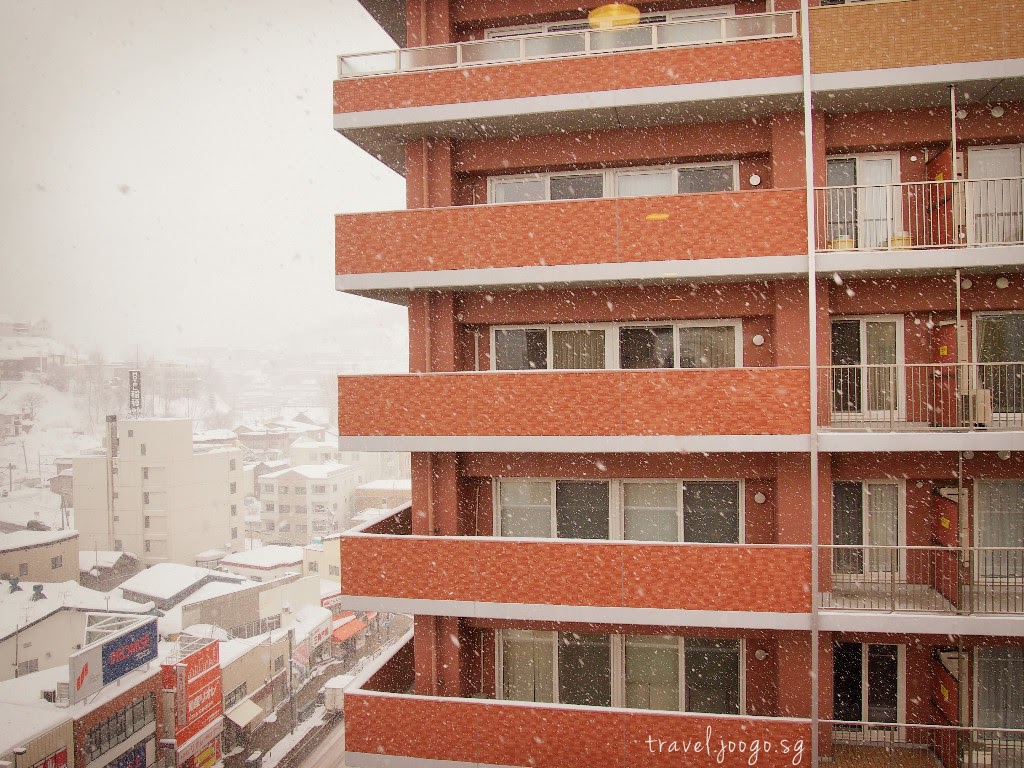
A red brick building was right opposite our room. Be sure to close your curtains to avoid exposing yourselves. Otherwise, the room view was great! If you like a great view, request for higher floors, but if you want to use the hotel amenities at level 2, it’s better to stay at lower floors. And if you don’t like high foot traffic, avoid level 2.
Room & Toilet
Next, the room. The hotel didn’t look much from the outside but the interior is very, very well equipped.
The room was not very big, but it had everything you need for a comfortable stay – comfortable bed, sufficient heating, kettle for drinks, refrigerator, air purifier, television and a fully-equipped toilet. The room is quite well-designed in our opinion, so that there’s sufficient space for movement and luggage.
We walked by rooms with tatami floor and took a quick peep inside, they looked slightly bigger.
Open the main door, and you will see the wash basin, and a small clothes rack is behind the main door.
Hotel Amenities
Interesting feature in the lift–a chair to rest on. Open the lid and you will find useful items during an emergency.
A big reason we will definitely recommend the hotel is the complimentary onsen. It’s a public onsen (separate male and female public bath). It’s a great place to relax those aching muscles. I didn’t use the onsen, but Mr S did, and he said it was huge and crowded – different from the intimate one we tried at Niseko and Noboribetsu (which i adore!).
Photo Credit: Booking.com
The hotel has different pools of water with different mineral properties. There is also a sauna. After soaking, Mr S even had a complimentary bowl of hot noodles in the restaurant. Only happens during winter evenings. Perfect comfort food after coming out from a nice onsen session.
Overall, a very comfortable stay for a very affordable rate. Highly recommended.