When overseas, I like visiting hair salons to try out the local trends. Did it in Hong Kong but ended up with an epic fail boy’s cut. Also did it in Taiwan and cringed at the frizzy limp perm, and on hindsight I think the …
Day Trip or 2D1N to Mount Seorak (Seoraksan) We were planning a day trip from Seoul to Mount Seorak (“Seoraksan”) until we found out about the travelling time. It is about 6 hours to and fro. Accounting for Baby E’s 7:00 PM bedtime, we will only …
Editor’s Note: This post was originally published in October 2018 and has been updated in December 2018 for accuracy and comprehensiveness.
Running out of ideas what to do in Seoul? Hop on to a rail bike and ride on. There are two places near Seoul where you can experience this fun activity–Gapyeong and Gangchon Rail Park. Here’s a post mainly about Gangchon Rail Park.
Even though we are going to Nami Island before this, we decided on Gangchon Rail Park instead. Reasons being: ‘Running Man’ was filmed there (I’m an avid fan!), the scenery is better, four tunnels are being passed through instead of one, less distance to cycle as the last part is a scenic train ride, and lastly, there’s an option for VR experience!
About Gangchon Rail Bike
Pedal the bike along discontinued railroad tracks and enjoy the Bukhangang River scenery. Pedalling makes the bike go faster, but you can only go as far as the bike is in front of you, unless of course you are the first one. If you are tired, rest your legs and allow your partners to do the hard work, or let the bike go slow on auto pilot. In any case, the bike is going on a slight down slope.
Begin your rail bike experience from Gimyujeong Station. Ride 6km to a pit stop and rest for 20 mins. Afterwards, enjoy the scenic train ride to the Old Gangchon Station (end point). You can take the free shuttle bus at the parking lot of Old Gangchon Station and return to Gimyujeong Station (the starting point).
It’s best to set aside 2 hours for this activity. The whole experience, including the train ride and shuttle bus transfer, takes about 1.5 hours. You might want to add another 30 minutes for buffer in your schedule.
How to get to Gangchon Rail Bike Park?
Gangchon Rail Bike Park is a 5-minute walk from Gimyujeong subway station.
From Seoul
By train, there are two ways to travel from Seoul to Gangchon Bike Park (Gimyujeong station).
Option 1: Subway all the way (alight at Gimyujeong station)
Option 2*: Subway + ITX-Cheongchun Line + Subway
Take subway to the ITX station
Alight from ITX at Namchuncheon Station
Take a subway to Gimyujeong Station
ITX is a high speed train that supposedly shortens the travelling time. Certain websites recommend not to take ITX because many passengers missed their train, waited 30 minutes for the next one and ended up late for this booked activity. According to them, not much time is saved with ITX anyway.
*Option 2 is similar to how we get from Seoul to Nami Island. So for ITX details, you can refer to Step 1 and 2 of the post, “From Seoul to Nami Island“. Advisable to book ITX tickets online in advance.
From Nami Island
After alighting from the ferry at Gapyeong wharf, take the intra-city bus (green bus) or cab back to Gapyeong Station. And from Gapyeong Station, take a subway to Gimyujeong Station.
Leaving Gangchon Rail Park
Option 1: Shuttle Bus to Gimyujeong Station
As I’ve mentioned, you can take the free shuttle bus at Old Gangchon Station, the end point. After you alighted from the train station, you need to walk to a parking lot. You can refer to the map below for reference.
From the train, walk towards a (car road) bridge and turn left unto it. At the bridge, there’s the map (photo below) to locate the shuttle bus stop. Follow the yellow arrows to the shuttle bus. The bus will bring you back to Gimyujeong Station, the entrance of the Rail Park.
We took the subway from Gimyujeong to Namchuncheon station for the ITX. We boarded the ITX and alighted at Wangsimni, where we took the subway (green line 2) to EWHA.
You can leave straight from the end point and not take the free shuttle bus. In this case, you can either walk or take a taxi to Gangchon subway station. Walk 1.5 km for about 20 mins. Otherwise, take a 5-minute ride on taxi for ₩3,000 (S$3.70, US$2.70).
Booking Gangchon Rail Park Bike Tickets
Because of the popularity and limited quantity of the two seater bikes, it’s better to book your Gangchon Rail Park tickets soon! Moreover, book early for your desired timing. There are specific timings you have to choose from.
Booking of Gangchon Rail Bike Tickets (2-Seater or 4-Seater):
Children under 36 months may sit on the lap of a paying adult for free. However, insurance doesn’t cover that child.
If you are also going to Nami Island, consider booking a fuss free tour package via Klook that includes both Gangchon Rail Bike and Nami Island. Have fun cycling!
Disclosure: Some of the links in this post are affiliate links. Affiliate link means I’ll get a small commission if you make a purchase. There’s NO extra cost to you. I appreciate your support to maintain this website, so that I can share more tips with you. Thank you!
Travelling with a Toddler to South Korea (Seoul and Jeju) Be sure to bookmark this page as I update my itinerary of South Korea. It’s our second trip with E. She’s now a toddler! A different ball game when she was an 8-month-old infant during …
There are quite a few ways to get from Seoul to Nami Island, and I got a bit confused while searching for the perfect way. So after doing my research, I’ve come up with a step by step guide of how to get from Seoul …
“Two bus tickets to Nagasaki, please. Via Hakata.” The ticketing officer at Fukuoka Airport looked at us in bewilderment. Then, he tried his best to explain in English that it was a bad idea. Upon his advice, we got the bus tickets that brought us straight from Fukuoka Airport to Nagasaki (click link to find out why it was a bad idea).
From Nagasaki Bus Station to the Hotel
After a 2.5-hour bus ride, we reached the standalone bus interchange that had neither a shopping mall nor an information counter nearby. We muddled out of the bus interchange with our luggage and baby to look for our bus stop. It was supposed to be just opposite the station. Should be easy peasy.
Photo unrelated. This was taken somewhere in Nagasaki. Read on to find out. We were too in shock to take any photos at this point.
Our jaws dropped. We walked nearer to the main road and took a closer look. Are we getting this right? It was a huge intersection with NO traffic lights.
“How do we get up there?” I pointed to that seemingly complicated criss-cross overhead bridge. We walked a few more steps and saw the long flight of stairs. Should we have taken the bus via Hakata, which would have brought us near to our hotel?
“It’s too difficult for us to carry our luggage and baby up. Let’s take a cab instead,” hubby suggested.
As if the taxi drivers knew this would happen, there were a few taxis readily parked nearby. Told the taxi driver our destination, Hotel Belleview Nagasaki Dejima, and he nodded his head and said, “Okay, okay,” in the Japanese way. Even though hubby insisted on carrying our heavy luggage up, the old taxi uncle grabbed, lifted and tucked them into the big boot space. Felt bad, because he looked old enough to be my grandfather!
Stay: Hotel Belleview Nagasaki Dejima (Review)
The Room
A quick check-in at Hotel Belleview Nagasaki Dejima and… FINALLY THE BED! After a red-eye flight to Fukuoka and another bus ride to Nagasaki, we were sooo tired. My two babies were concussed for a while before we headed out again! The double bed (1.4m wide) in the room was smaller than a queen, so it was a bit of a squeeze for the three of us at night. Our initial booking was for a semi-double, which is only 1.2m wide! Good that we up-sized the bed.
It wasn’t a huge room. There wasn’t even a wardrobe, but just a few wall hooks to hang your stuff. Needless to say, the toilet was small. Actually, the size was not too surprising for Japan, except I thought it would be bigger in Nagasaki, where there’s more “land” than in Tokyo.
The Breakfast
The hotel breakfast buffet is commendable as well. It’s not crowded, and the food, mainly Japanese cuisine, was quite delicious. This was where Baby E got her first taste of Japanese rice! See her happy, grainy face in the photo below. Get your food tray at the entrance and fill it up. You can even take the food tray up and dine in the comfort of your hotel room!
Overall
Overall, we would recommend this hotel. The service from the reception counter to the restaurant is good. The staff are helpful and friendly, such a contrast to the ones in Fukuoka.
Important Information
Our Booking
Double Room with Double Bed. Breakfast Included.
2 weekday nights: 20,400yen (S$250.50)
Public, off-site parking is available for 1080.00 yen (S$13.30) per stay. You don’t need to make reservations, but it’s still better to email and ask!
Nagasaki (長崎) is a port city on Kyushu Island and the capital of Nagasaki Prefecture.
Dejima Wharf (Lunch and Walk)
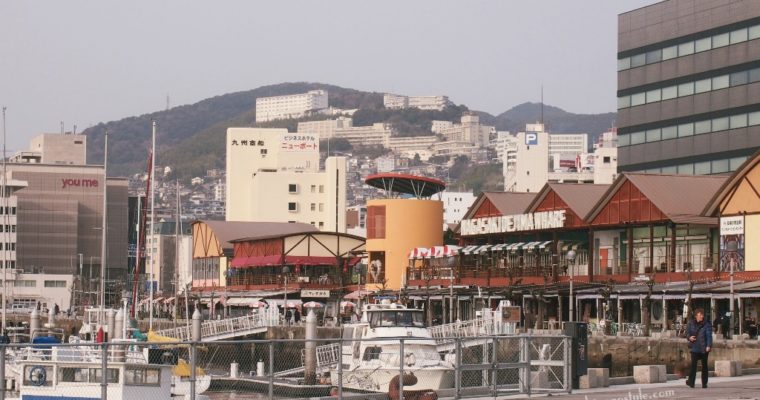
After the short nap, we sauntered our way to Nagasaki Dejima Wharf. It’s about a 7-minute walk from our hotel in the cool weather. Ships and boats of various sizes were docked at the quiet Nagasaki Harbour.
Restaurants selling a variety of cuisine and other shops such as beauty salons can be found on the first and second floors of Dejima Wharf. But we didn’t explore the second floor as our baby was asleep in her stroller and we couldn’t find a lift.
It’s a nice and cosy place to dine outdoors, but the place didn’t really have that atmosphere found in other Fisherman’s Wharf. How’s the food then?
We dined at Delicious Restaurant Attic, where we had pasta, cake and their famous Ryoma Yataro Cappuccino. Read our review in ‘5 Foods to Eat in Nagasaki‘. Btw, if Italian cuisine is not your cup of tea, try the sashimi don or fried chicken at Kaisen Ichiba Nagasakiko. Yes, we went back to Dejima Wharf again the next day just to try Kaisen!
Dejima Wharf and Beyond
Nagasaki Seaside Park
After the late lunch, we decided to stroll to the Glover Garden and digest a bit. Wrong move. What started as a 1.3km journey became much longer. We got lost and wandered into a big park, Nagasaki Seaside Park. It’s a nice place to chill and have a picnic, except we were on a tight schedule.
Nagasaki Prefectural Art Museum
Near Dejima Wharf, we also came across the Nagasaki Prefectural Art Museum. I really love visiting art museums, but I think it might be hard to handle an 8-month-old in a quiet museum. So we had to skip this museum that has an extensive collection of Spanish art, one of the largest in East Asia. Of course, it also features art related to Nagasaki, displaying works produced since the Meiji period.
Admission is only 400yen (S$5), and it closes every second and fourth Mondays. For more info, visit www.nagasaki-museum.jp/english
Glover Garden and Oura Church
“I’m so tired!” I panted and tried to catch my breath as I spoke. “Let me sit down to rest a bit.”
Hubby chuckled. Even with a sleeping baby strapped to him, he was still going strong. After a long walk from Dejima Wharf to the vicinity of Glover Garden and Oura Church, I wasn’t expecting more walking and slopes to climb.
The place was a maze, and we got lost a bit, and when we finally found the garden’s entrance, I was deadbeat. Sadly, we could only oogle and walk past all the shops along the way because the Glover Garden was closing soon at 6:00 PM during winter. And all shops were closed when we came out of the Glover Garden. At least, we managed to pop into this little shop to get Castella Cake. :)
Hamnomachi Shopping Arcade & Chinatown (Shop and Dinner)
Time for dinner! We headed towards the direction of Nagasaki Chinatown and Hamnomachi Shopping Arcade. We searched high and low for Izumiya, a well-hidden Unagi restaurant in Chinatown.
The wooden sliding door opened just as we were about to open it. An old auntie in uniform, with a shoulder bag hooked on her arm, stared back at us. It took her a few seconds before she came to a realisation and gestured with an apologetic look, “Sorry, we’re closed.” My heart sank; it was only 6:00 PM. I wanted badly to dine here.
Among the various shops, including greengrocers, discount shops and local speciality shops, we could perhaps find another restaurant to dine in. I was cheered up a little by the beautiful red lanterns hanging from above the main walkway in Chinatown. There were also zodiac animal light displays mounted along the way. They were all part of “Nagasaki Lantern Festival”, a tradition that illuminates Nagasaki’s winter every Lunar New Year.
In the backdrop of red vibrancy, we found that most restaurants were closed relatively early or were too crowded or tiny to accommodate us with a baby and a stroller. We were too tired to search anymore, and it was getting late.
So reluctantly, we had McDonald’s for dinner. Two meals for 1,130yen (S$13.90). We climbed up to the seating area on the second floor and squeezed among the youth studying and chatting in low voices. Baby E’s whimpers were loud in the quiet fast-food restaurant. And there we were, eating the palatable but nothing to wow about meal as we carried the baby to eat her Donki’s sweet potato, enjoying the pleasant respite.
Day Two in Nagasaki
Nagasaki’s Streetcar / Tram
Quick breakfast at Hotel Belleview Nagasaki Dejima, and we’re off to explore more of Nagasaki. We were excited for our first ride on the city’s tram or streetcar! This type of transportation always gives the resident city a nostalgic, old-city feel.
A single trip is 120 yen (S$1.50), regardless of distance, while a one-day pass is 500 yen (S$6.20). Informative e-brochures can be found on the top page of visit-nagasaki.com/GettingAround.
It is easy to get around the city with the streetcar. Nagasaki City itself is quite small, and the attractions are not far from one another. We could pass by the same place a few times while heading elsewhere. Compared to Tokyo, Nagasaki is a small, quiet and slow-paced town.
Izumiya, Unagi Restaurant (Lunch)
Before heading further up north to the Atomic Bomb Museum, I wanted to go back to Izumiya for their Unagi. Good thing they were open when we were there for early lunch. Glad we made that decision! The just-about-right charred unagi was so tantalising. Find out more in ‘5 Foods to Eat in Nagasaki‘.
Site of the Martyrdom of the 26 Saints of Japan
As we departed from the Ohato area to the Atomic Bomb Museum, our streetcar passed by the Site of the Martyrdom of the 26 Saints of Japan. Had we had time, we would have alighted at Nagasaki Ekimae streetcar station to visit the site’s monument and museum (500yen, S$6.20).
The monument faces Oura Cathedral, which is also dedicated to the martyrs. If you are interested in learning about the history of Christianity in Nagasaki – from the rise, to persecution, to revival – do visit the museum that is behind the monument.
Background of the 26 Martyrs
On February 5, 1597, Toyotomi Hideyoshi executed 26 Catholics as a public warning to Japanese converting to Christianity. Toyotomi was a preeminent daimyō, warrior, general, samurai, politician, and Japan’s second “great unifier”.
Of the 26 Martyrs, 6 were foreign missionaries, and 18 were Japanese Christians. They were forced to walk 800km from Kyoto and Osaka to Nagasaki, which was chosen for its significant Christian population. 2 more Catholics joined them along the way. They took one month to reach Nishizaka Hill, where they were publicly executed. This public crucifixion marked the beginning of a two-century-long Christian persecution in Japan, where many more were martyred.
Atomic Bomb Museum and Peace Park
On another sober note, we finally reached the Atomic Bomb Museum, which is adjacent to the Peace Park at Ground Zero. On 9 August 1945, at 11:02 am, the exact moment when the atomic bomb destroyed many innocent lives in Nagasaki.
Join us as we revisit this heart-wrenching part of history in “Nagasaki Atomic Bomb Museum and Peace Park“. You will find many remnants of the horrific event displayed, witness accounts recounted, and feelings penned. At Ground Zero, part of the destroyed Urakami Cathedral still stands.
The irony of Urakami Cathedral: Public crucifixion of the 26 martyrs didn’t stamp out the Christian community in Nagasaki. Instead, it flourished, and 250 years later, it was discovered that there were thousands of baptised Christians in Nagasaki, living their faith in a secret catacomb, unknown to the government. International pressure stopped the government from persecuting these underground Christians again. The revitalised Christian community then built the massive Urakami Cathedral, which was ironically destroyed at Ground Zero by American Christians.
Horaiken Bekkan (Lunch Option)
Collectively, the Atomic Bomb Museum and Peace Park are quite a huge area to explore. So it might be a good idea to break the tour into two parts, rest and have lunch nearby before continuing. You can try Nagasaki Champon, the local speciality, at nearby Horaiken Bekkan
However, we were too tired and time-pressed to climb up the flight of stairs to Horaiken Bekkan. So we went to Dejima Wharf again (where we had our lunch on our first day). And there we had a sashimi don bowl and fried chicken. Was the bowl nicer than the one we had in Otaru? Find out in ‘5 Foods to Eat in Nagasaki‘. ;)
Nagasaki Dejima
If you still have time, you can consider visiting Dejima, the “replanted” Site of the Former Dutch Trading Post. The original Dejima is a fan-shaped island constructed in 1636 to segregate foreigners from the Japanese population during national seclusion from 1641 to 1859.
The original Dejima’s historical structures and reconstructions, such as the residences, warehouses, and gates, have now come together at the current site. Experience what life was like back then in Dejima while you rent and dress up in a traditional Kimono. It’ll be interesting to take photos of in kimonos and against a backdrop of Japan-meets-West buildings.
Currently, Nagasaki City is engaging in plans to restore Dejima to its 19th-century state, with plans to dig canals on all four sides to make it like an island.
Dejima tram station (right next to Dejima)
Daily, 8:00 to 6:00 PM (until 7:00 PM in summer and peak), admission ends 20 minutes prior
510 yen (S$6.30)
Mount Inasa
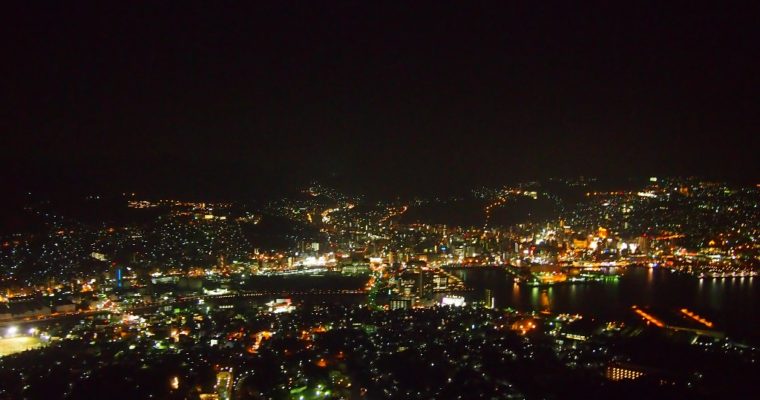
After a day of hustling, it’s time to enjoy the ten-million-dollar night view at Mount Inasa. It is said to be one of Japan’s three best night views. Is it worth taking the trip up to Mount Inasa? Find out in ‘Night View of Mount Inasa (Nagasaki)‘.
I’ve compiled an amateurish video to show the different parts of Nagasaki, including Mount Inasa’s night view. Play the video below and have a peek into the land of Nagasaki!
After Nagasaki, we drove to Kumamoto, and then to other parts of Kyushu. Read our interesting road trip experience with a baby: Self-Drive in Northern Kyushu (Winter).
Disclaimer: JoogoStyle and Christina accept no liability (whether in tort or contract or otherwise) for any loss or damage arising from any use, misuse, inaccuracy or omission of the information or other contents published on this website.
About Mount Inasa The night view of Mount Inasa (稲佐山, Inasayama) is said to be one of Japan’s three best night views. The other two belong to night views from Mount Hakodate, and of Mount Rokko and Mount Maya. The former has a panoramic view …
About Nagasaki Glover Garden and Oura Church Glover Garden Glover Garden (グラバー園, Glover-en) is located on the hill where Western merchants settled down after the end of Japanese government’s Seclusion Policy in 1853. It is a large sprawling garden which houses the Former Glover Residence …